

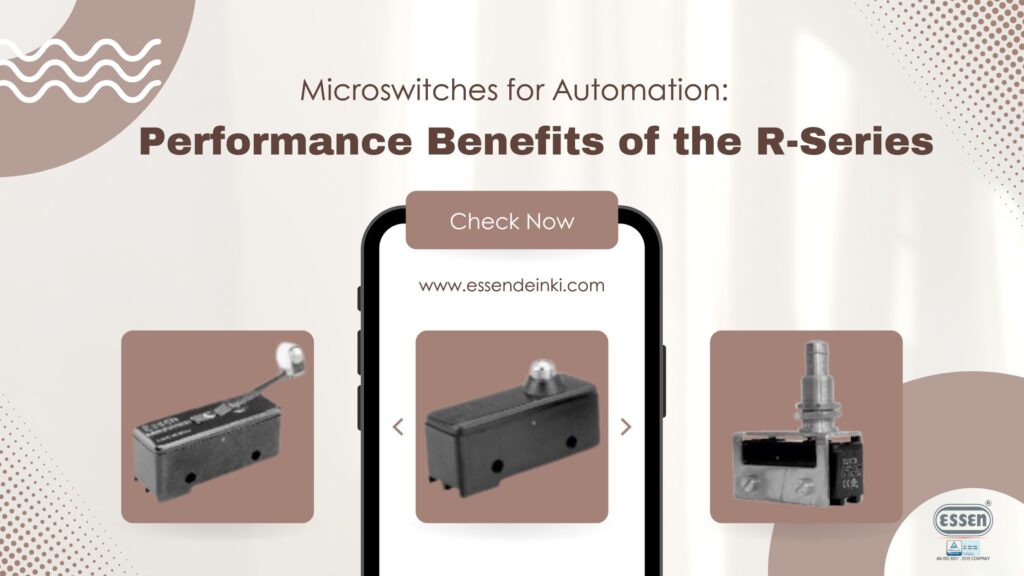
Types of microswitches play a critical role in industrial automation and electrical control systems. In any industrial automation system, precision and reliability are not just goals—they are absolute necessities. As machines become more advanced, the small components that trigger critical actions must perform flawlessly, millions of times over. The Essen R-Series Microswitches are engineered specifically for these high-stakes environments, delivering dependable performance, a high electrical load capacity, and the long service life needed for demanding automation.
These switches are the unseen workhorses in complex machinery. Understanding what makes them effective can help you design more robust and efficient systems. This guide breaks down the performance benefits of the R-Series, from their internal construction to their practical applications in automation.
What’s Inside? Precision Engineering for Durability
The strong performance of the R-Series microswitch starts with its core design. Each switch is a single-pole changeover, snap-acting device built around a beryllium copper trident spring mechanism. This material is not a random choice; beryllium copper offers outstanding fatigue resistance, which ensures a consistent and crisp “snap” action even after millions of cycles. This prevents the switch from getting “stuck” or failing to actuate, which is critical for operational safety and consistency.
Key Construction Highlights:
- Fine Silver Contacts: These provide excellent electrical conductivity and strong resistance to oxidation. This helps maintain low contact resistance over long periods, ensuring signals pass through without degradation.
- Robust Terminal Design: The solder tag terminals are secured with M3 screws, creating reliable electrical connections that hold firm, even in industrial settings prone to vibration.
- IEC 1058-1 Compliance: All R-Series models conform to international safety and performance standards. This makes them a reliable choice for automation applications intended for the global market.
How Do Actuators Make the R-Series So Versatile?
Automation systems operate under vastly different mechanical conditions. One machine might need a switch activated by a light touch, while another requires activation from a fast-moving cam. To support this diversity, the R-Series offers a wide range of actuator styles, allowing engineers to select the perfect switch for each specific task.
Pin and Spring Plunger Models
Models like the MR-8 and MRH-8 are ideal for applications that require very small operating movements. They feature a tight movement differential, as low as 0.025 mm, which allows for extremely precise control. For more flexible mounting needs, the MRP-16 has a large spring plunger suitable for both single-hole and side-mount installations.
Lever and Roller Variants
- MRL-8 Lever Type: This model uses a spring steel lever to reduce the operating force needed for actuation to approximately 110 grams. It is perfect for systems where the actuating component is lightweight or applies minimal pressure.
- MRR-9 Roller Type: Equipped with a self-lubricating nylon roller, this switch is designed for applications involving cams or sliding parts. The roller minimizes friction and wear, ensuring smooth performance over a long lifespan.
Understanding the Technical Specifications
The R-Series microswitches are engineered with clear mechanical and electrical limits to guarantee safe and consistent operation. Knowing these values helps you integrate them correctly into your designs.
| Specification | Value |
| Mechanical Life | 1 million operations |
| Electrical Life | 50,000 operations (at rated load) |
| Contact Resistance | 10 milliohms (max) |
| Insulation Resistance | 1000 megaohms (min) |
| Voltage Proof | 1 kV AC for 1 minute |
Electrical Load Ratings
These microswitches can also handle significant power, making them suitable for both low-voltage control circuits and certain power-switching applications.
- AC (Resistive): 15 A at 125V, 250V, or 440V
- AC (Inductive): 5 A at 125V or 250V
- DC (Resistive): 0.5 A at 125V or 0.25 A at 250V
Why Choose the R-Series for Your Next Automation Project?
Selecting the right microswitch is a small decision that can have a big impact on reducing machine downtime and long-term maintenance costs. The Essen R-Series delivers a powerful combination of benefits.
- High Mechanical Life: Engineered for long-term reliability in repetitive tasks.
- Strong Electrical Performance: Capable of handling heavy electrical loads safely.
- Durable Construction: Features like zinc-plated frames on select models resist corrosion.
- Flexible Mounting: Options include models with an 18 mm threaded length for easy panel depth adjustment.
By combining premium materials like fine silver contacts and beryllium copper springs with a wide range of actuator types, the R-Series provides a reliable and versatile solution for modern industrial automation.
FAQ: Your Questions About R-Series Microswitches
Q.1 What is a snap-acting microswitch?
Ans: A snap-acting switch is a type of switch that opens or closes a circuit in a rapid motion. This action is independent of how quickly the actuator is pressed. The internal mechanism, like the R-Series’ trident spring, stores energy and then releases it suddenly, creating a clean make or break of the electrical connection. This is vital for preventing arcing and ensuring reliable signaling.
Q.2 Can the R-Series be used for safety applications?
Ans: While R-Series switches are highly reliable for operational control (e.g., limit sensing, positioning), dedicated safety circuits often require switches that are specifically certified for safety functions (e.g., force-guided contacts). Always check your application’s specific safety requirements and standards.
Q.3 What is the difference between a resistive and an inductive load?
Ans: A resistive load (like a heater) has a constant current draw. An inductive load (like a motor or solenoid) creates a large voltage spike when the circuit is opened. That’s why the R-Series has a lower amperage rating for inductive loads—it’s designed to handle that back-voltage safely.
Q.4 How do I select the right actuator?
Ans: Consider how the switch will be activated.
- For direct, head-on actuation with high precision, use a pin plunger.
- For activation by a sliding or rotating part like a cam, use a roller lever to minimize friction.
- If you need to reduce the force required to activate the switch, use a plain lever.