

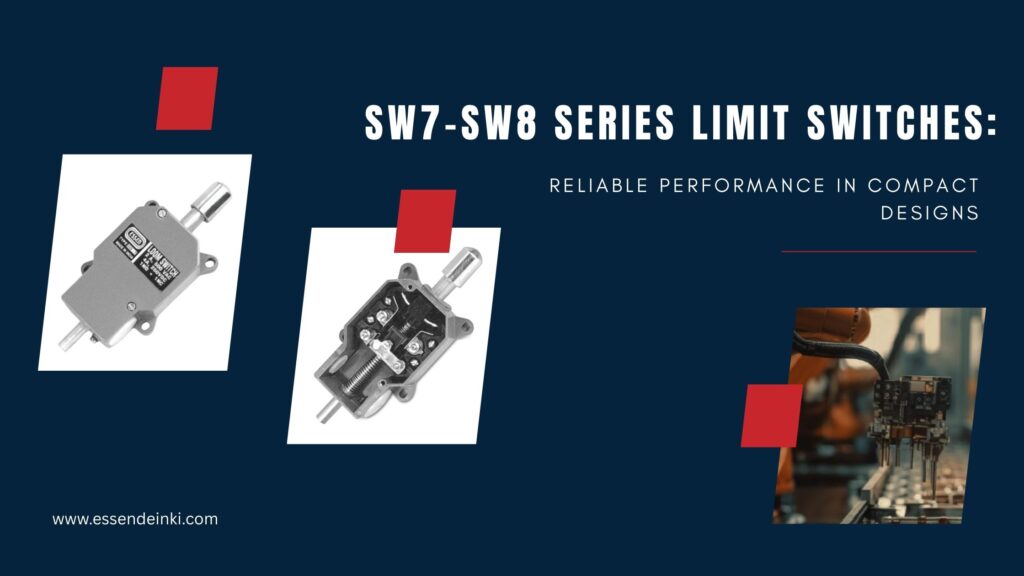
In industrial automation, the smallest components often carry the biggest responsibilities. Limit switches, for example, act as the critical “sensing points” for machines. They tell control systems about position, movement, and safety conditions, ensuring everything runs smoothly and safely. The SW7–SW8 Series Limit Switches from Essen Deinki are designed to deliver this vital information with dependable performance, a long service life, and a space-saving design perfect for demanding applications.
This guide will break down what makes the SW7–SW8 series a reliable choice for industrial environments. We will explore their robust construction, precise switching capabilities, and the specific applications where they excel.
What Makes the SW7–SW8 Series Stand Out?
The SW7–SW8 series is engineered to perform reliably day in and day out, even in harsh industrial and commercial settings. Their design focuses on durability, ease of installation, and precision.
Built for Tough Industrial Conditions
Each switch in this series features a rugged die-cast metal enclosure. This heavy-duty housing protects the sensitive internal components from dust, debris, physical impacts, and other mechanical stresses common in industrial plants.
Compact and Easy to Install
Despite their robust construction, these limit switches have a compact form factor that makes them ideal for installations where space is limited.
- Body width: 40.0 mm
- Main body length: 103.4 mm
For easy installation and wiring flexibility, the switches come with 3/4″ B.S. conduit threaded entries on both sides. This dual-entry design allows for seamless integration into new control panels and makes them excellent for retrofit applications, as wiring can be approached from either side.
Consistent and Accurate Switching Performance
The core function of a limit switch is precision, and this is a key strength of the SW7–SW8 series. These switches use a spring-loaded plunger mechanism that ensures smooth actuation and a reliable, crisp return after operation. This prevents the switch from sticking and guarantees consistent signaling.
To suit different control logic requirements, the series is available in two distinct contact configurations. This allows engineers to choose the exact switching sequence needed for their specific application.
SW7 Series Contact Configuration
- Features 1 Normally Open (NO) and 1 Normally Closed (NC) contact.
- The switching sequence is: NO contact closes before the NC contact opens.
SW8 Series Contact Configuration
- Features 1 NO and 1 NC contact.
- The switching sequence is: NO contact closes after the NC contact opens.
This flexibility is crucial for designing systems that require specific timing or fail-safe logic.
Key Technical Specifications
The SW7–SW8 series is designed for long-term stability and electrical safety, with specifications that ensure reliable performance over thousands of cycles.
| Specification | Value |
| Electrical Rating | 2 A at 500V AC |
| Maximum Actuating Force | 3 kg |
| Pre-travel | 5.1 mm |
| Total Plunger Travel | 17.8 mm |
| Dielectric Strength | 2 kV AC (rms) for 1 minute |
| Insulation Resistance | ≥ 1000 MΩ |
| Contact Resistance | ≤ 20 milliohms |
These specifications highlight the switches’ ability to handle significant electrical loads while maintaining signal integrity and safety.
Where Are SW7–SW8 Limit Switches Used?
Often called “loom switches” due to their traditional and widespread use in textile machinery, the SW7–SW8 series limit switches are highly versatile. Their durability and precision make them suitable for a wide range of industries and applications, including:
- End-of-travel detection in conveyor systems and cranes.
- Safety interlocking for machine guards and access doors.
- Position feedback in automated assembly lines.
- Control functions in heavy-duty industrial equipment.
- Material handling and packaging machinery.
Why Choose Essen Deinki?
With a legacy dating back to 1964, Essen Deinki has built a strong global reputation for quality and innovation in electromechanical components. The SW7–SW8 series reflects this expertise by offering a reliable, durable, and compact solution tailored for the needs of modern automation.
If you are an engineer or system designer looking for dependable limit switches that combine strength, precision, and ease of installation, the SW7–SW8 series is a smart choice that delivers on performance and longevity.
FAQ: Your Questions About SW7-SW8 Limit Switches
Q.1 What is the main difference between the SW7 and SW8 series?
Ans. The only difference is the contact switching sequence. In the SW7, the Normally Open contact closes before the Normally Closed contact opens. In the SW8, the Normally Open contact closes after the Normally Closed contact opens. Your choice depends on the specific logic required by your control circuit.
Q.2 What does “loom switch” mean?
Ans. This is a colloquial name for this type of limit switch, originating from its heavy use in the textile industry to control the operation of looms. Although they are now used across many industries, the name has stuck.
Q.3 Is the metal enclosure resistant to corrosion?
Ans. Yes, the die-cast metal enclosure is designed to be rugged and withstand typical industrial environments. For specific applications involving harsh chemicals or extreme moisture, it is always best to consult the detailed product datasheet.
Q.4 What is “pre-travel” in a limit switch?
Ans. Pre-travel is the distance or angle the actuator must move to trip the contacts (i.e., to change the state of the NO and NC contacts). For the SW7–SW8 series, this distance is 5.1 mm. This specification is important for designing the mechanical interface that will activate the switch.
To learn more and access detailed technical drawings, visit the SW7–SW8 official product page.