

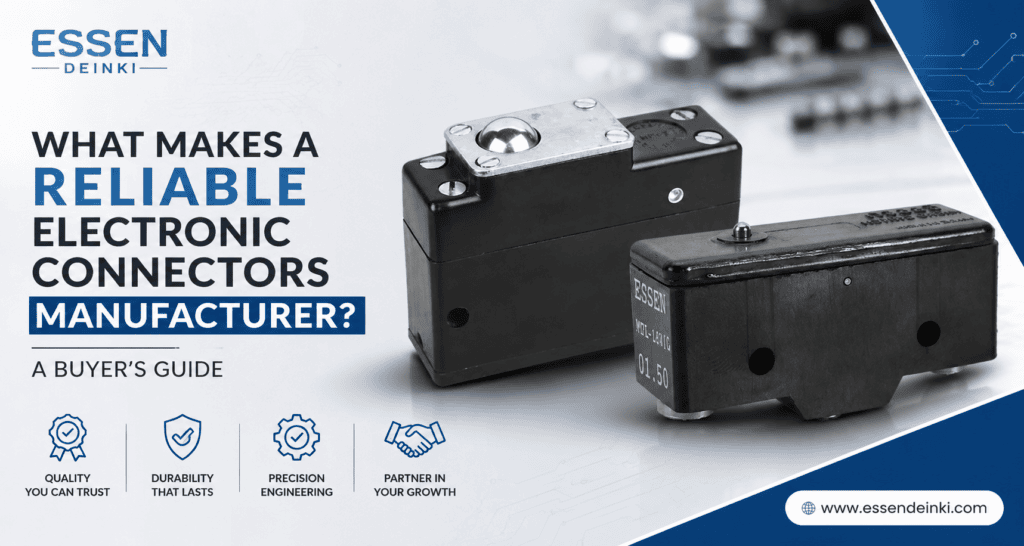
Quick answer: A reliable electronic connectors manufacturer demonstrates consistent product quality, effective quality control, clear specifications, sound application knowledge, dependable supply, and useful technical support. Buyers should evaluate these factors together—not choose based on price alone—to ensure connectors perform reliably across industrial and electronic applications.
Choosing electronic connectors is not simply about comparing prices or checking product availability. For industrial and electronic applications, connector reliability directly affects electrical connections, equipment performance, maintenance requirements, and production continuity. A weak connection in the wrong place can disrupt an entire system.
That’s why the choice of a supplier deserves careful thought. When you evaluate electronic connectors manufacturers, you’re not just buying a component—you’re depending on a partner whose consistency shapes how your equipment behaves in the field. In India’s growing base of OEMs, automation companies, and industrial equipment makers, sourcing decisions carry real weight.
This buyer’s guide breaks down the factors that separate a reliable manufacturer from an unreliable one. You’ll learn how to assess product quality, manufacturing consistency, technical expertise, quality control, application suitability, and supply reliability—so you can make an informed sourcing decision with confidence.
Why Choosing the Right Electronic Connectors Manufacturer Matters
The manufacturer behind a connector can matter just as much as the connector’s specification on paper. Two connectors may look identical in a datasheet, yet perform very differently over months of use. The difference usually comes down to how they were made.
Consider what’s at stake. Consistent product quality keeps your equipment running the same way, batch after batch. Reliable electrical performance protects the signals and power your systems depend on. Mechanical durability reduces failures caused by vibration, handling, or repeated mating cycles.
Manufacturing consistency also affects your own operations. When every order matches the last, your assembly lines and maintenance teams don’t waste time troubleshooting mismatched parts. Application suitability ensures the connector fits the environment it’s placed in. And steady product availability, backed by responsive technical support, keeps your sourcing predictable over the long term.
Every one of these factors ties back to a single question: can you trust this manufacturer to deliver the same quality, on time, every time? That trust is what you’re really buying.
What Makes an Electronic Connectors Manufacturer Reliable?
Reliability isn’t a single trait. It’s a combination of factors that show up in the product, the process, and the way the company works with you. Here are the areas worth examining closely.
Consistent Product Quality
Consistency is one of the clearest signs of a capable manufacturer. When connectors are used across production runs or fitted into multiple pieces of equipment, small variations can create big problems.
Look for dimensional consistency, so parts fit the same way every time. Material consistency matters too, because it keeps performance predictable. Contact reliability, tight manufacturing tolerances, and repeatable performance across batches all point to a well-controlled process. A reliable manufacturer treats the tenth order like the first.
Strong Quality Control Processes
Quality control is where good manufacturing shows its discipline. Effective checks help catch issues before connectors ever reach your facility.
Well-run quality processes can identify problems related to materials, dimensions, contacts, insulation, and assembly. They also verify finished-product consistency, so what leaves the factory matches the intended design. Ask how a manufacturer approaches quality checks—their answer often reveals how seriously they treat reliability.
Understanding of Industrial Applications
Connectors are selected according to their application, and a reliable manufacturer understands this well. The right choice depends on more than a part number.
Several conditions influence connector selection:
- The operating environment, including temperature, dust, and moisture
- Electrical requirements such as current and voltage
- Mechanical conditions like vibration and repeated connections
- Space constraints on compact boards or in tight enclosures
- Installation method and overall equipment design
A manufacturer who grasps these factors can guide you toward connectors that actually suit your setup.
Technical Knowledge and Product Guidance
When you’re unsure about specifications or compatibility, technical support becomes genuinely valuable. Not every buyer is a connector expert, and that’s fine.
A knowledgeable manufacturer can explain the available options and help you match products to your application requirements. This guidance reduces guesswork, cuts down on costly mistakes, and helps design and procurement teams move faster with fewer revisions.
Product Range and Application Flexibility
A manufacturer with a suitable range of electronic connector options makes sourcing easier, especially for businesses juggling different applications. A broad range can reduce the number of suppliers you manage.
That said, more isn’t automatically better. Evaluate whether the manufacturer’s range actually matches your requirements. A focused lineup that fits your needs beats a large catalogue full of products you’ll never use.
Customization Capability When Required
Some applications call for configurations that standard products don’t cover. In those cases, a manufacturer’s ability to adapt can be decisive.
If your project has unusual needs, it’s worth asking about:
- Custom configurations
- Specific dimensions
- Mounting requirements
- Connection requirements
- Application-specific solutions
Raising these questions early helps you understand whether a manufacturer can support your project beyond off-the-shelf options.
Reliable Supply and Consistent Availability
For OEMs, industrial manufacturers, and procurement teams, supply reliability is critical. Inconsistent supply creates purchasing headaches and can stall production entirely.
When you assess a supplier, weigh these points:
- Product availability when you need it
- Clear, organized order handling
- Reasonable lead times
- Consistency across repeat orders
- Responsive communication
A dependable electronic connector supplier keeps your operations predictable, which is worth far more than a one-time bargain.
Clear Product Specifications
Clear technical documentation helps you make informed decisions. Without it, you’re guessing—and guessing is expensive in industrial procurement.
Good specifications help you understand the connector type, configuration, electrical characteristics, mechanical characteristics, and mounting requirements. They also clarify application suitability. When a manufacturer publishes clear details, it signals confidence in what they produce.
Quality vs Price: What Should Buyers Prioritize?
The lowest initial price rarely tells the full story. A cheaper connector that fails early, arrives inconsistently, or lacks proper support can cost far more over time than a well-made alternative.
Instead of chasing the lowest number, think about total purchasing value. That means weighing quality, reliability, compatibility, consistency, availability, and technical support alongside price. A connector that performs reliably and ships on time protects your production schedule and your reputation.
None of this means expensive is automatically better. Price still matters. The goal is balance—paying for the quality and consistency your application genuinely needs, without overspending on features you’ll never use.
Questions to Ask an Electronic Connectors Manufacturer Before Buying
A short conversation with a potential supplier can reveal a lot. Rather than working through a rigid checklist, treat these as prompts to understand how a manufacturer operates.
Start by asking what connector types they manufacture and which applications those products are designed for. This quickly tells you whether their focus aligns with your needs.
Then dig a little deeper with questions like these:
- What quality-control processes do you follow?
- Are technical specifications and documentation available?
- Can you support repeat orders reliably?
- Are application-specific configurations available if I need them?
- What technical information should I provide before selecting a connector?
Clear, confident answers usually indicate a manufacturer who understands their products and their customers.
How to Compare Electronic Connectors Manufacturers in India
When you shortlist suppliers, a structured comparison keeps the decision objective. Instead of reacting to the first attractive quote, evaluate each option across the same set of factors.
A practical order of evaluation looks like this: product quality, then technical suitability, then manufacturing consistency, then quality control, then product range, then supply reliability, then support, and finally overall value. Price fits into that last stage—as part of value, not as the sole deciding factor.
While researching, it also helps to look beyond a company’s website. Buyers evaluating electronic connectors can check the Essen Deinki Google Business Profile for business information, reviews, and other available details before reaching out. It’s a simple step that adds context to your shortlist.
By comparing manufacturers this way, you avoid the trap of choosing on price alone and instead pick a partner who supports your application for the long run.
Quick Answer: What Makes an Electronic Connectors Manufacturer Reliable?
A reliable electronic connectors manufacturer should demonstrate consistent product quality, appropriate manufacturing capabilities, effective quality control, clear specifications, sound application knowledge, dependable supply, and useful technical support. Buyers should evaluate these factors together rather than selecting a manufacturer based only on price.
Where Essen Deinki Fits In
If you’re sourcing connectors for industrial automation, control panels, electrical equipment, or OEM products, it helps to work with a manufacturer that focuses on precision components. You can explore the available range of electronic connectors from Essen Deinki, including the P-Series and PBL Profile Series, both designed for engineers, OEMs, and system integrators.
The P-Series is built for demanding environments, with features like 2.54 mm contact spacing, selectively gold-plated contacts, and flame-retardant thermoplastic insulation. The PBL Profile Series offers a low-profile, compact design suited to space-conscious PCB layouts, with straight and right-angle solder pin options. Both lines offer flexible ordering choices, including contact plating classes and latch styles, so you can match connectors to your project needs.
Buyers who need something beyond standard options can discuss custom electronic connector solutions based on specific requirements. To see the full lineup or start a conversation about your application, visit the electronic connectors page and get in touch with the team.
Frequently Asked Questions
What should I check before choosing an Electronic Connectors manufacturer?
Check for consistent product quality, effective quality control, clear technical specifications, a suitable product range, dependable supply, and helpful technical support. Evaluate these factors together, and confirm the manufacturer understands your specific application before placing an order.
Why is quality control important for electronic connectors?
Quality control helps catch issues in materials, dimensions, contacts, insulation, and assembly before connectors reach you. Strong quality processes ensure consistent, reliable performance across batches, reducing failures, rework, and unexpected downtime in your equipment.
How do I know which electronic connector is suitable for my application?
Selection depends on factors like operating environment, electrical requirements, mechanical conditions, space constraints, and mounting method. Share these details with your manufacturer’s technical team, who can help you match the right connector configuration to your needs.
Why should I choose a manufacturer instead of only comparing suppliers?
A manufacturer controls product quality, consistency, and technical support directly. This often means better documentation, customization options, and reliable repeat orders—giving you a more dependable sourcing relationship than comparing resellers on price alone.
Make a Smarter Sourcing Decision
Selecting a reliable electronic connectors manufacturer takes more than comparing product prices. The real measure of a supplier is how well they combine quality, consistency, technical suitability, manufacturing capability, supply reliability, and buyer support. When those pieces align, you get connectors you can trust—order after order.
Use the evaluation factors in this guide to shortlist and compare your options with confidence. Then choose the partner who best fits your application, not just the cheapest quote on the table.
Need Help Choosing the Right Electronic Connectors?
If your business is sourcing electronic connectors and you’d like help identifying suitable options for your application, contact Essen Deinki to discuss your requirements. Explore the electronic connectors page to view the available range and start an enquiry with the team.