

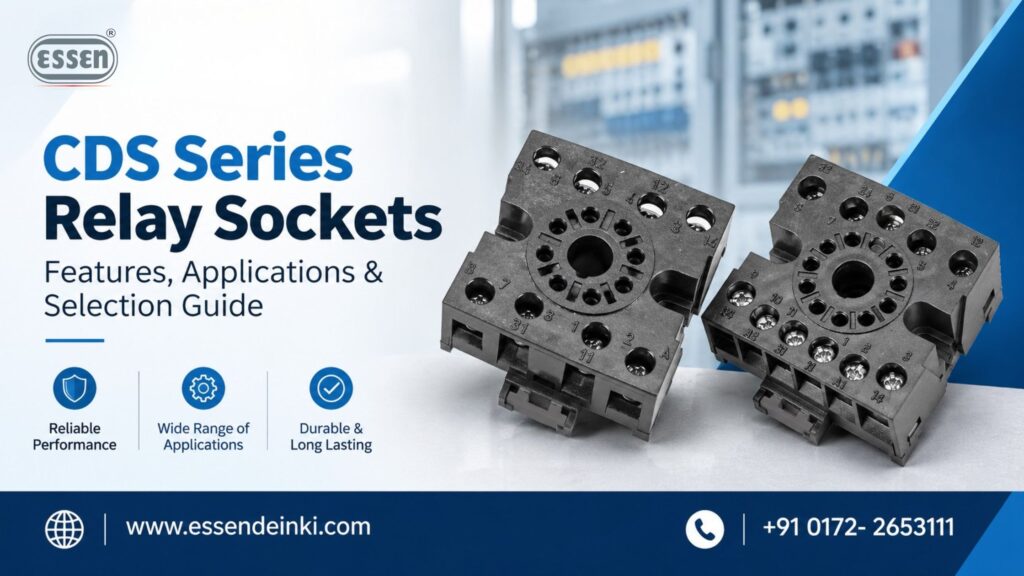
Quick answer: CDS Series relay sockets from Essen Deinki provide a mounting and connection base for compatible relays used in industrial control panels and automation systems. Selecting the right relay socket depends on relay compatibility, electrical ratings, mounting style, terminal configuration, and operating environment. This guide covers these factors so buyers can make an informed purchasing decision.
Choosing the correct relay socket is rarely the most exciting part of designing an electrical system, but it’s one of the most consequential. A mismatched socket can cause wiring headaches, installation delays, and unreliable connections down the line. For electrical engineers, panel builders, and procurement teams, getting this small component right saves time and money across the entire project.
This is where relay sockets, and specifically CDS Series relay sockets, come into the conversation. These components work alongside compatible relays to support electrical connections in industrial control panels, automation circuits, and machinery control systems. Understanding how they function — and what to check before buying — makes the selection process far more straightforward.
In this guide, we’ll break down what relay sockets do, introduce the CDS Series, explore their practical applications, and walk through a step-by-step selection process. By the end, you’ll know exactly what to verify before placing an order and how to reach Essen Deinki with any product-specific questions.
What Are Relay Sockets?
A relay socket is a mounting and connection base designed to hold a compatible relay in place within an electrical panel or control circuit. Instead of hardwiring a relay directly, engineers insert it into a socket, which handles the electrical connections between the relay and the surrounding circuit.
This arrangement offers several practical advantages. First, relay sockets provide a stable mounting and connection point for the relay. Second, they help establish the necessary electrical connections between the relay and the circuit. Third, in designs that support it, sockets make installation and relay replacement more convenient. Finally, they can simplify inspection and maintenance tasks in applications where quick access matters.
It’s worth noting that compatibility between a relay and a socket depends entirely on their respective designs. Not every relay fits every socket, so confirming the pairing before purchase is essential. This principle applies directly to the CDS Series relay sockets discussed below.
What Are CDS Series Relay Sockets?
CDS Series relay sockets are part of Essen Deinki’s product range, designed to work with compatible relays in industrial and control panel environments. As with any relay socket, the CDS Series is intended to provide a secure mounting and connection point that supports proper relay installation.
Because relay socket compatibility varies by model, buyers considering the CDS Series should review the official CDS Series product page for confirmed details on compatible relay types, mounting arrangements, terminal configuration, and electrical specifications. This ensures that any decision is based on verified information rather than assumptions carried over from other relay socket families.
For buyers evaluating the CDS Series relay sockets for a specific project, the most reliable approach is to cross-check the product page against your project’s wiring diagrams and relay specifications before finalizing an order.
Key Features of CDS Series Relay Sockets
When evaluating CDS Series relay sockets, buyers should focus on a handful of practical considerations that directly affect installation and long-term use. Rather than assuming every feature applies universally, it helps to check each point against the official product documentation.
- Relay compatibility: Confirm that the socket is designed to accept the specific relay model you intend to use. Pin configuration and socket arrangement must align.
- Secure electrical connections: A well-matched socket should provide a stable connection point, reducing the risk of loose or inconsistent contact over time.
- Mounting and installation requirements: Check how the socket is intended to be mounted within your panel or enclosure, and confirm this matches your layout.
- Terminal accessibility: Review the terminal layout to ensure it supports your wiring plan without requiring awkward workarounds.
- Ease of maintenance: In designs that support it, a properly matched socket can make relay inspection and replacement more convenient.
- Suitability for your equipment: Consider whether the socket’s design fits the broader control panel or equipment it will be installed in.
Where specific technical details aren’t listed publicly, it’s best to contact Essen Deinki directly to confirm the exact specifications for your application rather than relying on general assumptions.
Applications of CDS Series Relay Sockets
Relay sockets, including those in the CDS Series, are commonly used across a range of industrial and electrical settings. These environments typically require dependable connections between relays and the surrounding control circuitry.
Common application areas for compatible relay sockets include:
- Industrial control panels
- Automation and control circuits
- Electrical distribution and control assemblies
- Machinery control systems
- Manufacturing equipment
- Monitoring and switching applications
- Equipment maintenance and replacement work
In each of these settings, relay sockets support practical installation and ongoing maintenance needs. For example, in a manufacturing facility where relays need periodic inspection, a well-matched socket can make swapping out a relay far less disruptive than unwiring a hardwired connection.
That said, suitability for a specific application should always be confirmed against the CDS Series’ verified specifications and your project’s electrical requirements. Avoid assuming that a relay socket is appropriate for a given use case without checking compatibility first.
How to Select the Right CDS Series Relay Socket
Selecting the right relay socket involves more than picking a model off a catalog page. The following factors will help guide a more structured decision-making process.
1. Confirm Relay Compatibility
Check that the relay model, pin configuration, and socket arrangement all align. Even sockets that look similar can differ in pin layout, so this step should never be skipped.
2. Review Electrical Requirements
Compare the relevant voltage, current, and other ratings against the manufacturer’s specifications. This helps ensure the socket can safely handle your application’s electrical load.
3. Verify the Mounting Method
Confirm that the socket can be installed correctly within your intended panel or equipment. Mounting style often dictates how much space and hardware you’ll need.
4. Check the Terminal Configuration
Make sure the connection arrangement meets your wiring and installation requirements. Terminal layout affects how easily the socket integrates into your existing design.
5. Consider the Operating Environment
Factor in temperature, dust, moisture, vibration, and other environmental conditions relevant to your installation site. Harsh environments may call for additional protective considerations.
6. Evaluate Available Space
Review your panel layout, access points, wiring clearance, and maintenance requirements before finalizing a model. A socket that fits on paper may still be impractical in a tightly packed enclosure.
7. Plan for Maintenance Needs
Think about whether inspection, replacement, and troubleshooting can be performed conveniently with your chosen socket. This matters most in equipment that requires frequent servicing.
8. Confirm Manufacturer Documentation
Before placing an order, confirm the exact model number, technical specifications, and wiring details with the manufacturer. This step reduces the risk of costly ordering mistakes.
The table below summarizes these selection factors for quick reference.
| Selection Factor | What to Check | Why It Matters |
| Relay compatibility | Relay model and pin configuration | Helps ensure a suitable match |
| Electrical ratings | Manufacturer-specified voltage and current ratings | Supports safe, appropriate application |
| Mounting | Socket mounting arrangement | Helps confirm installation compatibility |
| Terminals | Terminal layout and wiring requirements | Supports correct connections |
| Environment | Temperature, dust, moisture, and vibration conditions | Helps assess application suitability |
| Model identification | Product code and technical documentation | Reduces ordering errors |
Common Mistakes to Avoid When Choosing Relay Sockets
Even experienced engineers can run into avoidable issues when selecting relay sockets. Being aware of these common mistakes can save significant time during installation.
- Selecting a socket without confirming relay compatibility. This is the most frequent cause of mismatched components.
- Ignoring electrical ratings. Overlooking voltage or current specifications can lead to unsafe or unreliable operation.
- Overlooking mounting requirements. A socket that doesn’t fit your panel layout creates unnecessary installation delays.
- Assuming all sockets share the same terminal arrangement. Terminal layouts vary between models, even within the same product family.
- Failing to check the operating environment. Conditions like dust or vibration can affect long-term performance.
- Ordering without confirming the exact model number. This simple step prevents costly reordering.
- Ignoring manufacturer installation instructions. Following documented guidance helps ensure correct setup from the start.
Avoiding these mistakes generally comes down to one habit: verifying details with the manufacturer before committing to an order. A quick confirmation call or email can prevent much larger problems later.
Why Choose the Correct Relay Socket for Industrial Systems?
Selecting the correct relay socket plays a meaningful role in how smoothly an electrical system comes together. A properly matched socket supports correct relay installation, which in turn helps maintain appropriate electrical connections throughout the panel.
Beyond installation, a suitable socket can make ongoing maintenance easier in compatible designs. Technicians can access terminals and replace relays with less disruption when the socket is correctly specified from the outset. This also contributes to a more organized panel layout, since components fit together as intended rather than requiring workarounds.
Most importantly, choosing a well-matched relay socket reduces the risk of compatibility-related installation issues. While no component can guarantee flawless performance indefinitely, careful selection remains one of the most effective ways to avoid preventable setbacks. Keeping CDS Series relay sockets at the center of this decision-making process helps ensure the final installation matches both technical requirements and practical maintenance needs.
Essen Deinki: Your Resource for CDS Series Relay Sockets
Essen Deinki offers the CDS Series relay sockets for industrial buyers, engineers, and procurement teams seeking components for control panels and automation systems. If you’re evaluating relay sockets for an upcoming project, reviewing the available CDS Series details is a useful first step.
Before finalizing your selection, consider contacting Essen Deinki to confirm:
- Product availability
- Model compatibility with your relay
- Technical specifications
- Installation requirements
- Suitability for your intended application
Reaching out directly ensures that your decision is based on accurate, up-to-date information rather than general assumptions. This is especially useful for procurement managers and system integrators who need confirmed details before finalizing purchase orders.
Frequently Asked Questions
What are relay sockets used for?
Relay sockets provide a mounting and connection point for compatible relays. They support electrical connections within industrial control panels, automation circuits, and machinery control systems, while also making relay installation and replacement more convenient in compatible designs.
What should I check before selecting a CDS Series relay socket?
Confirm relay compatibility, electrical ratings, mounting method, terminal configuration, and the operating environment. It’s also important to verify the exact model number and specifications with Essen Deinki before ordering.
Why is relay compatibility important when choosing a socket?
Relay compatibility determines whether the pin configuration and socket arrangement will actually fit together. Choosing a socket without confirming this can lead to installation delays or an unusable pairing.
Where can I find details about Essen Deinki’s CDS Series relay sockets?
Verified product information is available on the official CDS Series product page. For specific technical questions, contacting Essen Deinki directly is the most reliable way to confirm details for your application.
Ready to Select the Right Relay Socket for Your Project?
Choosing the right relay socket doesn’t have to be complicated when you know what to check. If your project calls for industrial, control panel, or automation-grade relay sockets, review the CDS Series product details and reach out to Essen Deinki to confirm the right model for your specific requirements.