

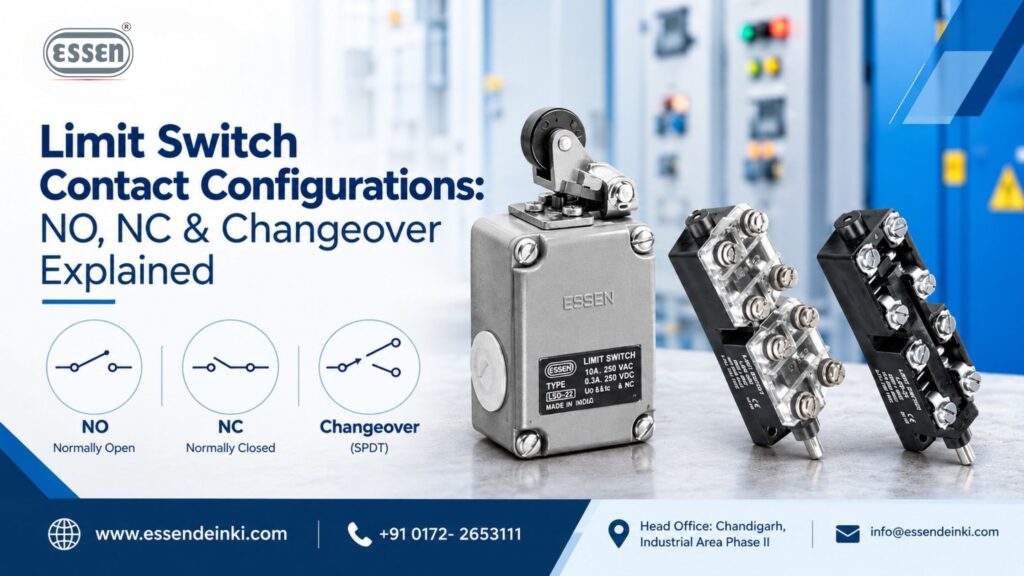
Quick answer: Limit switches use three main contact configurations — Normally Open (NO), Normally Closed (NC), and Changeover (SPDT) — to control circuits based on mechanical actuation. NO contacts stay open until triggered, NC contacts stay closed until triggered, and changeover contacts switch between two circuit paths simultaneously. Choosing the right configuration depends on your control logic, safety requirements, and application.
Selecting the correct contact configuration is one of the most overlooked steps in designing reliable industrial control systems. Get it wrong, and you risk nuisance trips, safety failures, or equipment damage. Get it right, and your machinery runs predictably for years.
Limit switches are a foundational component in automation, material handling, and machine safety circuits across Indian manufacturing plants. However, not all limit switches behave the same way electrically. Some close a circuit when triggered. Others open one. Some do both at once.
This guide breaks down the three core contact types used in limit switches — Normally Open (NO), Normally Closed (NC), and Changeover — and explains how each one works, where it’s typically applied, and how to choose the right configuration for your system. Whether you’re specifying equipment for a new production line or troubleshooting an existing panel, understanding these distinctions will help you make better purchasing decisions.
What Are Limit Switches?
A limit switch is an electromechanical device that detects the physical presence, position, or absence of an object and converts that mechanical movement into an electrical signal. Typically, an actuator (such as a lever, roller, or plunger) makes contact with a moving part of a machine, which then triggers an internal switching mechanism.
Limit switches are widely used in industrial automation to control motor circuits, signal end-of-travel positions, detect door or guard openings, and provide feedback in conveyor and packaging systems. Their mechanical simplicity makes them rugged and reliable, even in harsh environments involving dust, vibration, or moisture.
At the heart of every limit switch’s functionality is its contact configuration — the arrangement that determines how the internal circuit behaves when the switch is actuated. This is where NO, NC, and changeover contacts come into play.
What Is a Normally Open (NO) Contact?
A Normally Open (NO) contact remains in an open, non-conducting state when the limit switch is at rest. When the actuator is triggered — for example, when a moving part presses against the lever — the contact closes, allowing current to flow through the circuit.
In practical terms, an NO contact only “switches on” something when the switch is physically activated. This makes it well suited to applications where you want a signal, alarm, or motor to activate only upon contact.
Typical applications of NO contacts include:
- Starting a conveyor motor when a part reaches a specific position
- Triggering a counter when an object passes a sensor point
- Activating indicator lights upon machine engagement
Because the circuit stays open by default, NO contacts are generally used where the absence of a signal represents the “safe” or “idle” state of the system.
What Is a Normally Closed (NC) Contact?
A Normally Closed (NC) contact works in the opposite manner. In its resting state, the contact remains closed, allowing current to flow continuously. When the limit switch is actuated, the contact opens, interrupting the circuit.
This behavior is particularly valuable in safety-critical circuits. For example, if a wire breaks or the switch loses power, an NC contact circuit will open automatically — triggering a fail-safe shutdown rather than leaving a hazard undetected.
Common uses for NC contacts include:
- Emergency stop circuits and machine guarding interlocks
- Door or panel safety switches that cut power when opened
- Monitoring circuits where continuous current confirms a system is operating normally
Many Indian OEMs and panel builders prefer NC contacts for safety interlocks precisely because a fault condition — such as a disconnected cable — results in an automatic shutdown rather than silent failure.
What Is a Changeover Contact?
A changeover contact, sometimes called an SPDT (Single Pole, Double Throw) limit switch contact, combines both NO and NC functions within a single switching mechanism. Instead of simply opening or closing one circuit, a changeover contact switches between two separate circuit paths simultaneously.
In its resting state, one circuit path is closed (acting as NC) while the other remains open (acting as NO). When the switch is actuated, the positions reverse: the previously closed path opens, and the previously open path closes.
This dual-action behavior makes changeover contacts highly versatile. A single limit switch can be used to simultaneously stop one circuit and start another — for instance, de-energizing a forward motor relay while energizing a reverse relay in the same motion.
Typical applications of changeover configurations include:
- Reversing motor control circuits
- Dual-indication systems (one signal for “closed,” another for “open”)
- Complex automation sequences requiring synchronized switching
Because changeover contacts offer flexibility without needing two separate switches, they’re often specified in compact control panels where space and wiring simplicity matter.
NO vs NC vs Changeover: Key Differences
Choosing between these three limit switch configurations comes down to understanding how each behaves under normal and actuated conditions. The table below summarizes the key distinctions.
| Feature | Normally Open (NO) | Normally Closed (NC) | Changeover (SPDT) |
| Normal state | Circuit open | Circuit closed | One path closed, one open |
| State during actuation | Circuit closes | Circuit opens | Paths reverse simultaneously |
| Fail-safe behavior | Not inherently fail-safe | Fail-safe (opens on fault) | Depends on wiring configuration |
| Typical use case | Start signals, counters, indicators | Safety interlocks, e-stops, guarding | Reversing circuits, dual-signal systems |
| Wiring complexity | Simple | Simple | Moderate (two circuits) |
| Common industries | Packaging, material handling | Machine safety, access control | Motor control, automation panels |
This NO vs NC limit switch comparison highlights why configuration choice isn’t just a technical detail — it directly affects system safety and reliability.
How to Choose the Right Configuration
Selecting the correct limit switch configuration requires looking beyond the immediate wiring diagram. Several practical factors should guide your decision.
Control logic requirements. Determine whether your circuit needs to activate on contact (NO) or needs to default to an active state and shut down on contact (NC). This decision often depends on whether the “safe” state of your machine is powered or unpowered.
Safety and fail-safe needs. For safety circuits like emergency stops, guard interlocks, or door switches, NC contacts are generally preferred. This ensures that wiring faults or power loss result in an automatic stop rather than an undetected hazard.
Circuit complexity. If your application requires two coordinated actions from a single mechanical trigger — such as switching between forward and reverse — a changeover contact configuration eliminates the need for duplicate switches.
Operating environment. Consider vibration, dust, temperature, and moisture exposure. A mechanical limit switch rated for harsh conditions will perform more reliably regardless of contact type, so match the switch’s enclosure and build quality to your environment.
Maintenance and serviceability. Simpler NO or NC switches are often easier to troubleshoot in the field. Changeover switches, while more versatile, require more careful wiring verification during maintenance.
Equipment compatibility. Check your PLC inputs, relay logic, or control panel design to confirm which configuration the existing system expects before specifying a replacement limit switch.
Common Selection Mistakes
Even experienced engineers and procurement teams sometimes make avoidable errors when specifying limit switches. Being aware of these pitfalls can save significant rework.
- Assuming all limit switches are interchangeable. NO, NC, and changeover switches are not drop-in replacements for one another; mismatched configurations can cause circuits to behave in unintended ways.
- Overlooking fail-safe requirements in safety circuits. Using an NO contact where an NC contact is required for safety interlocks can leave a hazard undetected if wiring fails.
- Ignoring environmental ratings. Choosing a switch based solely on contact type while ignoring its ingress protection (IP) rating can lead to premature failure in dusty or wet environments.
- Underestimating actuator force and travel. Mismatched actuator types (roller lever, plunger, whisker) can cause unreliable triggering even if the contact configuration itself is correct.
- Skipping proper documentation review. Failing to cross-check the switch’s datasheet against your control panel’s wiring diagram often leads to installation errors.
Applications Across Industries
Limit switches, in their various contact configurations, are used extensively across Indian industrial sectors:
- Manufacturing: Detecting part presence on assembly lines, controlling automated clamps, and signaling machine cycle completion.
- Packaging: Triggering conveyor stops, detecting carton positions, and controlling sealing mechanisms.
- Material handling: Monitoring hoist and crane limits, detecting pallet positions, and controlling automated storage retrieval systems.
- Machinery and equipment: Providing end-of-travel feedback on CNC machines, presses, and hydraulic cylinders.
- Industrial automation: Supporting PLC-based control logic, interlocking safety guards, and enabling precise positional feedback in robotics.
In each of these settings, selecting the right configuration — NO, NC, or changeover — ensures the control system behaves predictably and safely under real operating conditions.
Why Consider Essen Deinki?
For engineers, panel builders, and procurement teams looking to specify reliable limit switches, Essen Deinki offers a range of industrial limit switches designed for various contact configurations and operating environments.
If you’re evaluating options for your next automation project or need to replace an existing switch, you can explore Essen Deinki’s limit switch range to review available configurations and specifications suited to your application.
Choosing the Right Contact Configuration Matters
Understanding the difference between Normally Open, Normally Closed, and changeover contacts isn’t just a technical exercise — it directly impacts the safety, reliability, and performance of your industrial control systems. NO contacts are ideal for simple activation signals. NC contacts provide fail-safe protection in safety-critical circuits. Changeover contacts offer flexibility for dual-action switching needs.
Before specifying your next limit switch, take the time to map out your circuit’s safe state, review your environmental conditions, and confirm compatibility with your existing control panel. A well-matched limit switch configuration reduces downtime, improves safety, and extends equipment life.
If you need guidance selecting the right limit switch for your application, contact Essen Deinki for professional consultation and support.
Frequently Asked Questions
What is the difference between NO and NC limit switch contacts?
A Normally Open (NO) contact stays open until the switch is actuated, closing the circuit upon contact. A Normally Closed (NC) contact stays closed until actuated, opening the circuit upon contact. The choice depends on whether your circuit should activate or deactivate upon triggering.
What is a changeover contact in a limit switch?
A changeover contact, also called an SPDT configuration, switches between two circuit paths simultaneously. One path closes while the other opens when the switch is actuated, allowing a single switch to control two separate circuits.
Which contact configuration is suitable for industrial automation?
It depends on the application. NO contacts suit simple activation signals, NC contacts suit safety interlocks and fail-safe circuits, and changeover contacts suit reversing motor control or dual-signal systems requiring synchronized switching.
How do I choose the right limit switch for my application?
Consider your control logic, safety requirements, operating environment, and existing equipment compatibility. For safety circuits, NC contacts are generally preferred due to their fail-safe behavior. For complex switching needs, changeover configurations offer added flexibility.