

Limit Switches
- Overview
- Characteristics
- Products
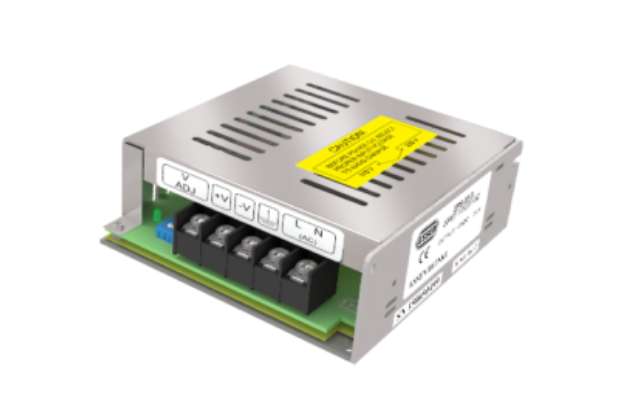
- Output Voltage- 5V or 12V or 24V DC, adjustable upto + /- 10% with inbuilt Potentiometer.
- Efficiency- About 82% at full load [24V dc only]
Characteristics
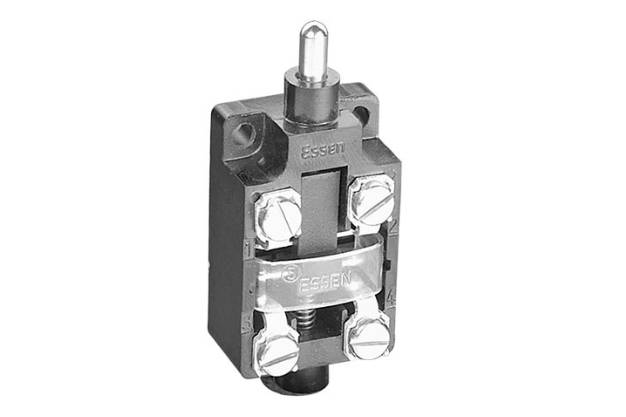
- 1 NO + 1 NC,1NO + 2 NC, 2 NO + 1 NC, 2 NO + 2 NC contacts.
- Silver contacts are designed for low contact resistance.
- Long mechanical & electrical life.
- Robust contact springs.
- Can be operated at frequencies as high as 3000 switching cycles/ hr.
- Available in open execution or in aluminum alloy diecast housing.
- Roller Lever switches can be operated from 4 directions in step of 90°.
- Snap action limit switches are designed for extremely low operating speeds.
- Switch elements with a cover are also available.
- Conform to IEC 947-5-1 standard.
Product
Description
Ordering Code
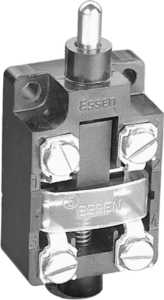
LSO/*LSO-C
- Design
- Enclosure
- Actuating force
1 NO + 1 NC
Normal action mechanism NC opens before NO closes
Open execution
1.0 Kg.(max.)
Ordering Code
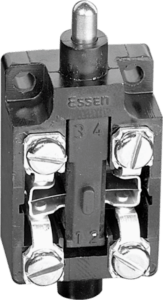
LSOS/*LSOS-C
- Design
- Enclosure
- Actuating force
1 NO + 1 NC
Snap action mechanism
Open execution
1.5 Kg.(max.)
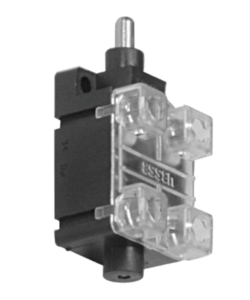
Ordering Code
LSO-CP/*LSOS-CP
- Design
- Enclosure
- Actuating force
1 NO + 1 NC
Snap action mechanism
Open execution
1.5 Kg.(max.)
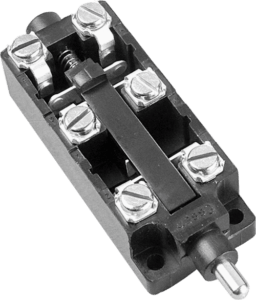
Ordering Code
LS0 -12/* LS0 -1 2C
- Design
- Enclosure
- Actuating force
1 NO + 2 NC
NC opens before NO closes
Open execution
1.0 Kg.(max.)
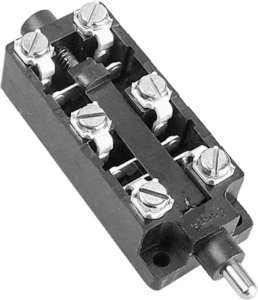
Ordering Code
LS0-21/*LS0 -21C
- Design
- Enclosure
- Actuating force
2 NO + 1 NC
NC opens before NO closes
Open execution
1.0 Kg.(max.)
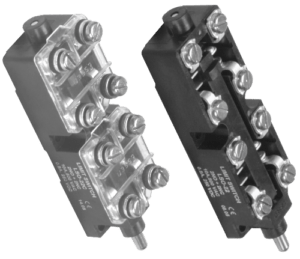
Ordering Code
LS0-22/*LS0 -22C
- Design
- Enclosure
- Actuating force
2 NO +2 NC
NC opens before NO closes
Open execution
1.0 Kg.(max.)
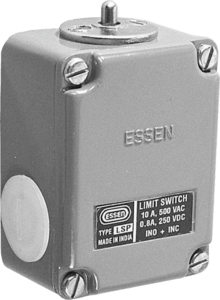
Ordering Code
LSP
- Design
- Enclosure
- Actuating force (In direction of stroke)
- Diecasthousing with gasket
NC opens before NO closes
Diecast housing with push rod
1.0 Kg.(max.)
Ordering code – LSPG
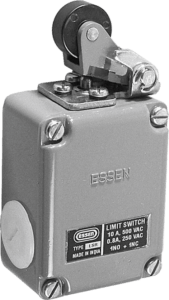
Ordering Code
LSR
- Design
- Enclosure
- Actuating force
- Diecasthousing with gasket
1 NO + 1 NC
NC opens before NO closes
Diecast housing with roller lever
0.75 Kg.(max.)
Ordering code – LSRG
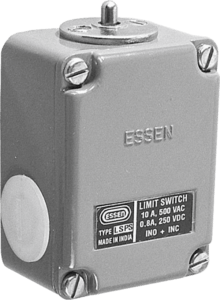
Ordering Code
LSPS
- Design
- Enclosure
- Actuating force
- Diecasthousing with gasket
1 NO + 1 NC
Snap Action Mechanism
Diecast housing with push rod
1.5 Kg.(max.)
Ordering code – LSPSG
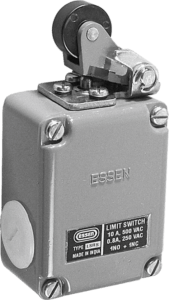
Ordering Code
LSRS
- Design
- Enclosure
- Actuating force
- Diecasthousing with gasket
1 NO + 1 NC
Snap Action Mechanism
Diecast housing with roller lever
1.2 Kg.(max.)
Ordering code – LSRSG
Technical Data
Electrical ratings
Mechanical life
Contact life
Temprature and Humidity
Contact resistance
Dielectric strength
Insulation resistance
10 A at 500V AC
0.4 A at 440V DC non-inductive
0.8 A at 250V DC non-inductive
15,000,000 switching cycles (typical)
Upto 15,000,000 switching operations
depending on breaking current (see graph)
All switches are designed for use
upto an ambient temprature of
50°C and 85% R.H.
20 milliohm max.
2kV AC rms
1000 Mohms min.
Industrial Limit Switches
Limit Switches for Industrial Automation & Control Systems
Limit switches are electromechanical devices used to detect the presence, position, or movement of objects in industrial systems. These switches play a critical role in automation, safety control, and machine positioning applications. Industrial limit switches are widely used in manufacturing plants, control panels, elevators, packaging machines, CNC systems, and material handling equipment.
At Essen Deinki, we manufacture high-performance limit switches designed for durability, precision operation, and long service life in demanding industrial environments.
What Are Limit Switches?
Limit switches are position-sensing devices that operate when a moving object makes physical contact with the switch actuator. Once activated, the internal contacts change state, either opening or closing the electrical circuit.
They are commonly used for:
• Position detection
• End-of-travel control
• Machine safety interlocking
• Motion control systems
• Industrial automation applications
These switches provide reliable snap-action switching, ensuring precise control and repeatability.
Types of Limit Switches
Different types of limit switches are available depending on actuator design and application requirements.
1️⃣ Roller Lever Limit Switch
Used in conveyor systems and automation lines where continuous movement is involved.
2️⃣ Plunger Type Limit Switch
Ideal for compact spaces and direct mechanical actuation.
3️⃣ Rotary Limit Switch
Commonly used in hoists, cranes, and heavy-duty applications.
4️⃣ Heavy Duty Limit Switch
Designed for rugged industrial environments with high mechanical stress.
5️⃣ Micro Limit Switch
Smaller in size, used in precision equipment and control panels.
Choosing the right limit switches depends on operating force, environmental conditions, electrical rating, and mounting configuration.
Working Principle of Limit Switch
The working principle of a limit switch is based on mechanical actuation. When an object comes into contact with the actuator (lever, roller, or plunger), it triggers an internal spring mechanism that changes the contact state.
This snap-action mechanism ensures:
- Quick switching
- Reduced contact arcing
- High electrical life
- Consistent repeatability
Because of their simple design, limit switches are highly reliable and require minimal maintenance.
Applications of Limit Switches
Industrial limit switches are widely used across multiple sectors:
- CNC machines
- Packaging machinery
- Elevators and lifts
- Conveyor systems
- Material handling equipment
- Robotics and automation systems
- Industrial safety doors
- Control panels
They ensure safe operation by preventing over-travel and detecting precise mechanical positions.
Why Choose Essen Deinki Limit Switches?
At Essen Deinki, we focus on precision engineering and quality manufacturing standards.
• Made in India
• Durable metal housing
• High switching capacity
• Reliable snap-action mechanism
• Custom actuator options available
• Strict quality control standards
Our limit switches are designed to meet industrial automation requirements while maintaining safety and operational efficiency.
Frequently Asked Questions (FAQs)
1. What is a limit switch used for?
Limit switches are used to detect object position or movement in industrial machines. They help control motion, prevent over-travel, and enhance safety in automation systems.
2. How does a limit switch work?
A limit switch works through mechanical contact. When an object presses the actuator, the internal contacts change state, opening or closing the electrical circuit.
3. What are the types of limit switches?
Common types of limit switches include roller lever switches, plunger switches, rotary switches, heavy-duty switches, and micro limit switches.
4. What is the difference between a limit switch and a micro switch?
A micro switch is a smaller snap-action switch often used in compact devices, while a limit switch is generally used for position detection in industrial machinery.
5. Where are limit switches commonly used?
Limit switches are used in CNC machines, elevators, conveyor systems, packaging machines, robotics, and industrial control panels.