

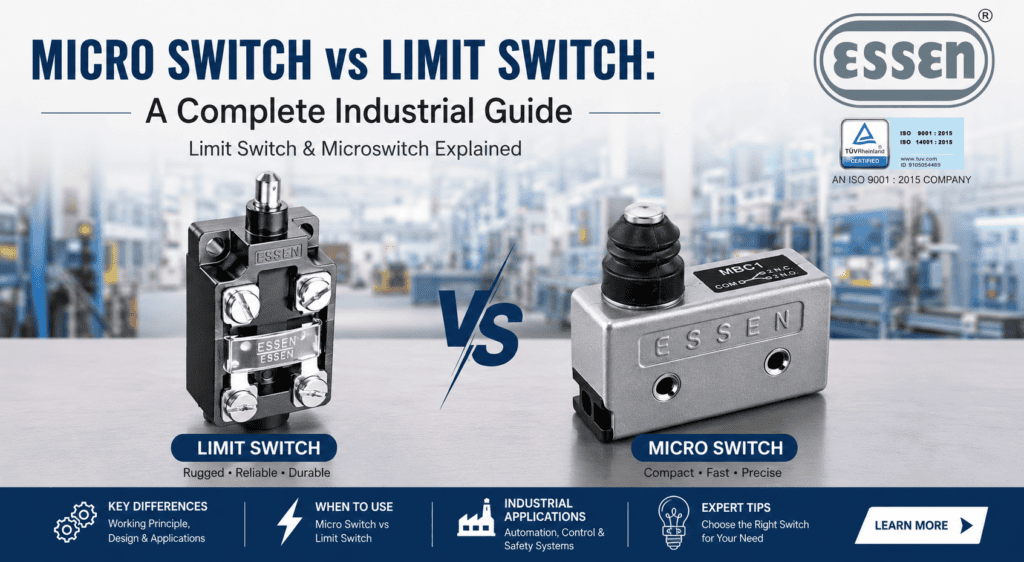
A micro switch and a limit switch both detect mechanical movement, but they serve different industrial purposes. Micro switches are compact, fast-acting, and suited for light-duty sensing tasks. Limit switches are ruggedized, built for harsh industrial environments, and designed for position detection in heavy machinery. Choosing the wrong one can compromise machine performance, safety, and uptime.
If you’ve ever specified components for an automation line, a CNC machine, or a conveyor system, you’ve faced this question: micro switch or limit switch—which one belongs in your application?
The confusion is understandable. Both are electromechanical devices. Both detect physical movement and trigger an electrical signal. At first glance, they seem interchangeable. But selecting the wrong switch for your machine can lead to premature failure, false signals, safety hazards, or costly downtime—none of which any engineer, OEM, or maintenance team wants to deal with.
This guide breaks down the limit switch microswitch comparison in full detail. You’ll learn how each switch works, where each performs best, what mistakes to avoid during selection, and how to make the right call for your specific industrial application. Whether you’re an automation engineer in Pune, a procurement manager in Delhi, or a machine builder in Coimbatore, this guide is written for you.
What Is a Micro Switch and How Does It Work?
A micro switch—formally called a miniature snap-action switch—is a small electromechanical switch that operates on a snap-action mechanism. When a small physical force is applied to its actuator (typically a lever, plunger, or roller), the internal spring mechanism “snaps” the contacts from one position to another almost instantaneously.
This snap-action is what makes micro switches reliable and consistent. The switching action happens at a precise, repeatable point regardless of how slowly or quickly the actuator is pressed. That precision is critical in applications where consistent response is non-negotiable.
Key Characteristics of a Micro Switch
- Small form factor: Compact design suitable for tight installation spaces
- Low operating force: Requires minimal mechanical force to actuate
- High cycle life: Rated for millions of operations under correct conditions
- Fast switching: Near-instantaneous contact transition
- Lower IP ratings: Generally less protected against dust and water unless specifically enclosed
Micro switches are commonly used in appliances, vending machines, printers, medical devices, door interlocks, and light-duty automation equipment.
What Is a Limit Switch and How Does It Work?
A limit switch is an electromechanical position sensor designed to detect the presence, absence, or position of an object—particularly moving machine parts. When a moving part (like a conveyor belt arm or crane hook) contacts the switch’s actuator head, the internal contacts change state, sending a signal to the control system.
Unlike micro switches, limit switches are purpose-built for industrial environments. They feature robust metal or reinforced plastic housings, higher IP protection ratings, and actuator heads designed to withstand repeated mechanical impact.
To understand the full technical detail behind how these devices operate, refer to this in-depth guide on limit switch working principles by Essen Deinki.
Key Characteristics of a Limit Switch
- Heavy-duty construction: Metal housing with sealed internals for tough environments
- High IP ratings: Typically IP65 or above, suitable for dust, oil, and water exposure
- Multiple actuator types: Roller lever, plunger, whisker, rotary—matched to application
- Higher current and voltage ratings: Handles industrial-grade electrical loads
- Longer wiring runs: Designed for integration into PLC-based control panels
Limit switches are widely used in conveyors, CNC machines, overhead cranes, injection moulding machines, elevators, and industrial automation systems.
Limit Switch Microswitch: Side-by-Side Comparison Table
Understanding the limit switch microswitch difference becomes straightforward when you compare them directly across key parameters.
| Parameter | Micro Switch | Limit Switch |
| Size | Small/compact | Medium to large |
| Housing Material | Plastic | Metal or reinforced plastic |
| IP Rating | IP40–IP54 (varies) | IP65–IP67 (standard industrial) |
| Operating Force | Low (few grams to newtons) | Moderate to high |
| Current Rating | 0.1A – 15A (typical) | Up to 10A–15A (industrial rated) |
| Cycle Life | 1 million – 10 million+ ops | 1 million – 30 million+ ops |
| Environment Suitability | Indoor, light-duty | Outdoor, industrial, harsh |
| Actuator Types | Lever, plunger, roller lever | Roller, rotary, whisker, rod
|
| Cost | Lower | Higher |
| Installation | Panel mount, circuit board | Machine frame, equipment housing |
| Response Precision | Very high snap-action precision | High, application-dependent |
| Typical Applications | Appliances, medical, light automation | CNC, conveyor, cranes, heavy machinery |
Micro Switch vs Limit Switch: Key Differences Explained
How does operating environment affect switch selection?
This is often the deciding factor. Micro switches perform reliably in clean, dry, controlled environments. Expose them to coolant spray, metal chips, or heavy vibration—as found on a machine tool—and they will fail far sooner than rated.
Limit switches are built for exactly those conditions. Their sealed housings protect internal contacts from contamination. On a CNC machining centre or a metal stamping press, a limit switch is the correct industrial switching solution by design.
How does switching force and actuator type affect the choice?
Micro switches respond to very light forces. That’s ideal when a small plastic component needs to trigger a signal without applying excessive mechanical load. Limit switches, by contrast, accept higher actuation forces and offer a broader range of actuator heads—roller levers, rotary actuators, and more—to match different machine geometries.
What about electrical load requirements?
Both switches can handle similar current ratings in many cases. However, limit switches are specifically tested and rated for inductive industrial loads—motors, solenoids, and relay coils—which generate voltage spikes on switching. Using a micro switch on such loads without proper suppression will degrade contacts quickly.
Industrial Applications: Which Switch Fits Which Machine?
When to use a micro switch in industrial settings
- Door interlock systems on enclosures and safety panels
- Presence detection for small components on assembly lines
- End-of-travel sensing in light-duty actuators or robotic grippers
- Control panel buttons and jog switches in operator interfaces
- Vending machines and dispensing equipment
When to use a limit switch in industrial settings
- Conveyor belt position detection: Detecting pallet arrival at a station
- Overhead crane and hoist travel limits: Preventing over-travel at end positions
- CNC machine axis homing: Confirming tool or table position at startup
- Injection moulding machines: Mould open/close position verification
- Elevator door and floor detection: Safety-critical position confirmation
- Industrial gates and doors: Access control and safety interlocking
As a general rule: if your application involves outdoor exposure, high vibration, coolant, dust, or oil—choose a limit switch. For clean, indoor, light-duty applications where compactness matters—a micro switch is typically sufficient.
Common Mistakes When Selecting a Limit Switch Microswitch
Even experienced engineers make avoidable errors during switch selection. Here are the most common ones:
- Selecting by price instead of environment rating
Choosing a micro switch because it costs less, then installing it in a wet or dusty area, leads to early failure. The short-term saving becomes a long-term maintenance cost. - Ignoring actuator geometry
The actuator type must match how the machine part physically contacts the switch. Using a plunger-style limit switch where a roller lever is needed causes uneven wear and missed detections. - Overlooking electrical load type
Switching inductive loads (motors, solenoids) without arc suppression damages contacts. Always verify the switch’s inductive load rating, not just its resistive load rating. - Underestimating cycle frequency
A switch rated for 1 million operations sounds like a lot—until you realise a high-speed machine cycles 500 times per hour. Calculate the actual operational lifespan before specifying. - Using a micro switch where a limit switch is the industrial standard
Certain applications—conveyor travel limits, crane end stops, heavy machinery position sensing—have a limit switch as the established industrial standard for good reason. Substituting a micro switch in these positions is a reliability and safety risk.
How to Choose Between a Micro Switch and Limit Switch: A Practical Framework
Ask yourself these questions before specifying:
- What is the operating environment? Dust, moisture, oil, vibration → Limit switch. Clean and dry → Micro switch may be suitable.
- What is the electrical load? Inductive industrial loads → Limit switch with proper rating. Light resistive loads → Micro switch.
- What is the available installation space? Very tight space → Micro switch. Standard machine mounting → Limit switch.
- What is the required IP protection? IP65 or above needed → Limit switch. IP40–54 acceptable → Micro switch with appropriate housing.
- What is the cycle frequency and expected lifespan? High-cycle heavy-duty → Limit switch. Moderate cycle, light duty → Micro switch.
Answering these five questions will guide you to the right limit switch microswitch selection for most industrial applications.
Why Essen Deinki for Industrial Switching Solutions?
Essen Deinki has been manufacturing precision electronic components since 1964—over 60 years of engineering experience. With more than 10,000 sq. metres of production space across three centres in Chandigarh and a presence in 15 countries, Essen Deinki supplies both micro switches and limit switches to OEMs, machine builders, and industrial buyers across India and globally.
Their products are ISO 9001:2015 and ISO 14001:2015 certified, with UL/CSA-compliant testing processes. For engineers and procurement teams who need reliable, specification-grade industrial switching solutions—Essen Deinki is a manufacturer worth knowing.
Make the Right Switch Selection—Every Time
The limit switch microswitch decision comes down to three things: operating environment, electrical load, and mechanical interface. Micro switches offer compact, precise, cost-effective sensing for light-duty and indoor applications. Limit switches deliver the durability, sealing, and ruggedness that industrial machinery demands.
Getting this choice right protects your equipment, reduces maintenance costs, and keeps your production line running. Getting it wrong—even with a well-intentioned substitution—can introduce failure points that are expensive to diagnose and fix.
If you’re designing a new machine, upgrading a legacy system, or troubleshooting a recurring switch failure, the right industrial switching solution is one specification conversation away.
Contact Essen Deinki today to speak with a technical expert who can help you select the correct micro switch or limit switch for your specific application. Reach out at info@essendeinki.com or call +91 0172-2653111.
Frequently Asked Questions
What is the main difference between a micro switch and a limit switch?
A micro switch is a compact, snap-action device suited for light-duty, low-force applications in clean environments. A limit switch is a heavy-duty, industrial-grade position sensor designed for harsh environments with high IP ratings, robust housings, and compatibility with industrial electrical loads. The key difference lies in durability, environmental protection, and the scale of application.
Can a micro switch be used instead of a limit switch in industrial machines?
In some low-risk, light-duty applications, yes. However, in heavy machinery, outdoor installations, or environments with dust, oil, or vibration, substituting a micro switch for a limit switch significantly reduces reliability and lifespan. For most industrial machines, the limit switch is the correct specification.
What IP rating should I look for in an industrial limit switch?
For most industrial environments, IP65 is the minimum recommended rating—this provides full dust protection and resistance to low-pressure water jets. For washdown environments or outdoor installations with rain exposure, IP67 or higher is advisable.
How do I know when to replace a micro switch or limit switch?
Common signs include intermittent signals, failure to actuate at the correct position, visible housing damage, or contact resistance increase detected during testing. High-cycle applications should have switches replaced proactively based on manufacturer-rated cycle life, rather than waiting for failure.