

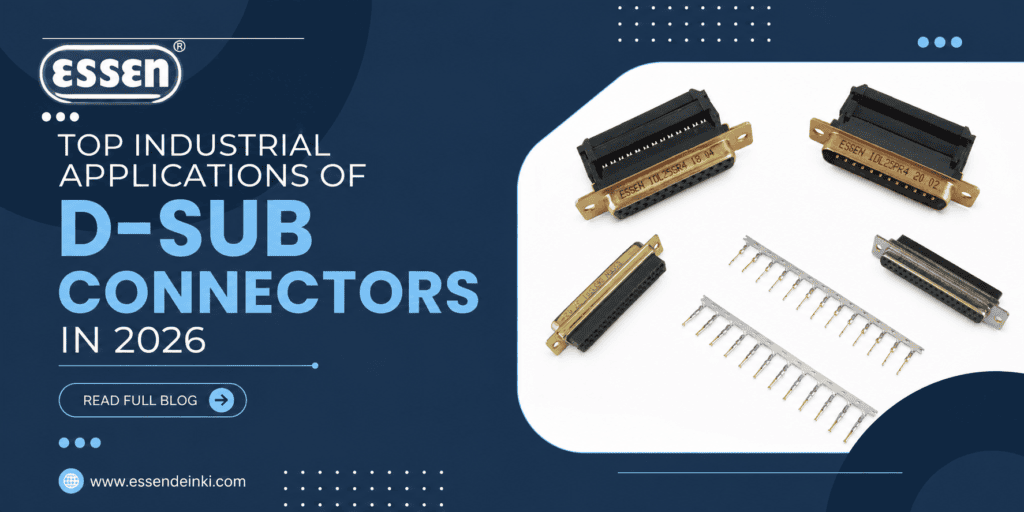
D-Sub Connectors are widely used across industrial automation, manufacturing, robotics, medical electronics, CNC machinery, and data communication systems. Their robust metal shell design, multi-pin configurations, and reliable signal transmission make them essential for control panels, PLC systems, and machine interfaces in modern industrial environments.
In modern industrial environments, reliable signal transmission and secure electrical connections are essential for smooth operations. D-Sub Connectors continue to play an important role across automation systems, manufacturing equipment, control panels, and electronic applications. As industries adopt smarter technologies in 2026, understanding the top industrial applications of D-Sub Connectors helps businesses choose the right connectivity solutions for their operations.
From factories in Pune to aerospace facilities in Bangalore, Indian industries are scaling up rapidly. Connectivity infrastructure is at the heart of this growth. D-Sub Connectors—compact, durable, and proven across decades—remain a go-to choice for engineers and system integrators who need dependable electrical connectors without compromise.
This guide covers where D-Sub Connectors are used, why they remain relevant, how to select the right type, and how Essen Deinki supports industrial businesses across India with high-quality connector solutions.
What Are the Main Industrial Applications of D-Sub Connectors?
D-Sub Connectors are used in industrial automation, manufacturing equipment, robotics, medical electronics, aerospace and defence systems, CNC machinery, testing instruments, and data communication systems. Their secure multi-pin interface, EMI shielding, and compatibility with industrial wiring solutions make them one of the most reliable electrical connectors for demanding environments.
Understanding D-Sub Connectors and Their Role in Industrial Systems
A D-Sub Connector—short for D-Subminiature Connector—is an electrical connector with a D-shaped metal shield. This shell provides mechanical strength and electromagnetic interference (EMI) protection. The connector is available in multiple pin configurations: 9, 15, 25, 37, and 50 pins.
These connectors transmit both power and data signals. They are available as PCB connectors, panel mount connectors, and cable mount connectors. Each type suits specific industrial wiring solutions and machine control systems.
D-Sub Connectors are compatible with a wide range of industrial electronic components—from PLCs and sensors to test instruments and automation panels. Their modular design makes them easy to replace, which reduces downtime and maintenance cost.
Why D-Sub Connectors Remain Relevant in 2026
Some connector technologies come and go. D-Sub Connectors have stayed relevant because of three core strengths: standardization, versatility, and durability.
Most industrial automation systems and legacy manufacturing equipment are built around D-Sub interfaces. Replacing them would require costly redesigns. As a result, industrial D-Sub Connectors continue to serve millions of machines globally.
Additionally, newer variants—such as high-density D-Sub and mixed-layout models—have extended the connector’s capabilities. These versions support higher pin counts in smaller footprints, meeting modern demands for compact and space-saving designs. The result is a connector that bridges legacy systems with next-generation industrial technology.
Top Industrial Applications of D-Sub Connectors
Industrial Automation and Control Systems
D-Sub Connectors are a core component in PLC (Programmable Logic Controller) systems and automation panels. They connect sensors, actuators, and controllers with precision. In control panel builds, automation connectors must handle continuous signal cycling without degradation.
D-Sub Connectors meet these demands through their secure locking mechanisms and multi-pin layout. They support reliable electrical connections between input/output modules and field devices—making them indispensable in factory automation across India’s manufacturing hubs.
Manufacturing Equipment and Machinery
Modern manufacturing equipment depends on consistent communication between components. D-Sub Connectors support machine-to-machine interfaces in production lines, CNC systems, and packaging units.
Their compatibility with industrial wiring solutions and robust housing ensures they perform in environments with vibration, dust, and heat. Maintenance professionals value how quickly they can be disconnected and reconnected during equipment servicing.
Robotics and Industrial Robots
Robotics applications demand connectors that are both compact and highly reliable. D-Sub Connectors are used in robot controllers, end-effector interfaces, and electronic sensor systems. They carry signals between the robot’s control unit and its moving parts without signal loss.
As robotic integration expands across Indian automotive and electronics manufacturing sectors, the demand for reliable automation connectors like D-Sub is increasing. Their high signal integrity makes them particularly suitable for precision robotic arms and collaborative robot platforms.
Aerospace and Defence Electronics
Aerospace and defence applications require connectors that maintain performance under extreme conditions—temperature variation, vibration, and pressure changes. D-Sub Connectors with sealed or ruggedized housings meet these criteria.
They are used in avionics panels, ground control systems, and communication hardware. The secure latching mechanism prevents accidental disconnection, which is critical in mission-sensitive environments. Heavy-duty connectors with corrosion-resistant housing—such as the 863 Series from Essen Deinki—are specifically engineered for these conditions.
Medical Equipment Manufacturing
Medical devices require connectors that are reliable, easy to clean, and compatible with electronic monitoring systems. D-Sub Connectors appear in diagnostic imaging equipment, patient monitoring systems, and laboratory instruments.
Their standardized pin configurations simplify equipment servicing. Medical OEM manufacturers benefit from the consistent electrical performance of industrial D-Sub Connectors across device revisions. For manufacturers in India’s growing medical electronics sector, this translates into lower certification costs and faster product development cycles.
Testing and Measurement Equipment
Industrial testing systems use D-Sub Connectors to interface with sensors, data loggers, and measurement instruments. Their multi-pin configurations allow multiple signal channels to pass through a single connector—simplifying wiring and reducing connector count.
Signal accuracy is non-negotiable in testing environments. D-Sub Connectors deliver low contact resistance and high dielectric strength, ensuring clean signal transmission throughout measurement cycles.
Communication and Data Transfer Systems
Data communication systems rely on D-Sub Connectors for serial and parallel data transmission. The RS-232 and RS-485 serial protocols—commonly used in industrial data systems—are built around D-Sub interfaces.
In industrial environments where data must move reliably between PLCs, HMIs (Human Machine Interfaces), and SCADA systems, D-Sub Connectors provide a proven and cost-effective solution. Their EMI shielding maintains signal integrity even in electrically noisy environments.
CNC Machines and Industrial Controllers
CNC machines depend on continuous, accurate signal exchange between the controller unit, spindle motors, and axis drives. D-Sub Connectors interface these components reliably, even during high-speed machining cycles.
Machine control systems built around D-Sub interfaces benefit from easy connector identification (thanks to the D-shaped polarization) and straightforward replacement. This reduces machine downtime during maintenance—a priority for production managers in Indian machining facilities.
D-Sub Connector Applications by Industry
| Industry | Application of D-Sub Connectors |
| Industrial Automation | PLC systems and control panels |
| Manufacturing | Machine communication and equipment connections |
| Robotics | Robot controllers and electronic interfaces |
| Testing Equipment | Signal transmission and measurement systems |
| Medical Electronics | Electronic device connectivity |
| Communication Systems | Data and signal transfer |
Key Benefits of Using Industrial D-Sub Connectors
Industrial D-Sub Connectors offer a strong combination of performance and practicality:
- Reliable signal transmission — Low contact resistance and EMI shielding maintain signal quality across long operational cycles
- Secure connections — The D-shaped locking mechanism prevents accidental disconnection in vibrating environments
- Durability — Metal shells and high-grade insulators withstand heat, dust, moisture, and mechanical stress
- Easy installation — Standardized pin layouts and color-coded housings simplify wiring and reduce installation time
- Versatile configurations — Available in 9 to 50 pin counts to match diverse application requirements
- Space-saving designs — High-density variants maximize connectivity in compact control panels
- Long service life — Quality materials extend connector lifespan, reducing replacement frequency
- Broad system compatibility — Compatible with most industrial automation systems, legacy equipment, and modern controllers
How to Select the Right D-Sub Connector for Industrial Applications
Choosing the correct D-Sub Connector depends on several application-specific factors. Getting this right the first time avoids costly rework and system failures.
| Selection Factor | Why It Matters |
| Pin Configuration | Determines connectivity requirements |
| Material Quality | Improves durability |
| Environmental Protection | Supports industrial conditions |
| Compatibility | Ensures system performance |
| Supplier Reliability | Provides long-term support |
Here is a practical breakdown of what to evaluate:
- Number of pins — Match the pin count to your signal or power channel requirements (9, 15, 25, 37, or 50 pin options)
- Environmental conditions — Select sealed or ruggedized variants for environments with oil, moisture, dust, or extreme temperatures
- Current and voltage requirements — Confirm the connector’s rated current and dielectric strength meet your application demands
- Connector quality — Look for flame-retardant insulators (UL94V-O), gold-plated or tin-plated contacts, and corrosion-resistant shells
- Mounting requirements — Choose between PCB connectors, panel mount, or cable mount based on your enclosure and wiring design
- Application type — High-speed data transmission applications require connectors with low contact resistance; power applications need higher current ratings
- Supplier reliability — A trustworthy D-Sub Connector supplier should offer technical support, consistent availability, and custom configuration options
Why Choosing the Right D-Sub Connector Supplier Matters
The connector itself is only part of the equation. A reliable supplier determines whether your supply chain stays consistent and your systems stay operational.
Here is what to look for in a D-Sub Connector supplier:
- Product quality — Connectors should meet recognized safety and performance standards (UL, CSA, RoHS)
- Technical support — Engineers and buyers need clear specification guidance to select the right product
- Industry experience — Suppliers with deep sector knowledge understand industrial application demands better
- Availability — Consistent stock availability prevents production delays
- Custom requirements — Specialized applications may need custom pin layouts, housing materials, or plating options
- Long-term reliability — A supplier committed to quality control ensures consistent connector performance across batches
Why Choose Essen Deinki for Industrial Connectors?
Essen Deinki has been manufacturing electronic components since 1964—bringing over 60 years of engineering expertise to Indian and global industrial markets. With 10,000+ square meters of production space across three centers in Chandigarh, and a presence in 15 countries, Essen Deinki is one of India’s most trusted names in electrical connectors and industrial electronic components.
Their Industrial D-Sub Connectors include the M Series, 863 Series, IDL Series, and C Series—each engineered for specific industrial conditions:
- M Series — Suitable for data processing, telecom, and instrumentation with 9 to 50 contact configurations
- 863 Series — Built for oil, water, and debris environments with corrosion-resistant sealed housing
- IDL Series — Handles dielectric strength up to 1000V and operates from -50°C to +105°C
- C Series — Rated for 5A current and 1000V dielectric strength with low contact resistance
Essen Deinki provides professional technical support, government-approved R&D, and high-speed precision stamping to ensure every connector meets the reliability standards of modern industrial applications. Whether you need standard configurations or custom pin layouts, their team can recommend the right reliable connector solutions for your specific requirements.
The Future of D-Sub Connectors in Industrial Systems
D-Sub Connectors will continue to serve industrial environments as long as PLCs, CNC machines, robotics systems, and legacy communication protocols remain in operation—which, by all indicators, will be for many years ahead.
As India’s manufacturing sector scales under initiatives like Make in India and Industry 4.0 adoption, the demand for proven, cost-effective industrial connectors will only grow. D-Sub Connectors offer exactly what industrial buyers need: a mature, standardized, and adaptable connectivity solution that fits both modern and existing systems.
Investing in high-quality connectors now—from a supplier with the expertise and stock to support you long-term—is one of the simplest ways to protect operational uptime and reduce maintenance costs across your facility.
Frequently Asked Questions (FAQs)
What are D-Sub Connectors used for in industrial applications?
D-Sub Connectors are used in industrial automation, PLC systems, CNC machinery, robotics, medical equipment, and data communication systems. They provide reliable signal transmission and secure electrical connections in environments that demand consistent performance over long operational periods.
How many pin configurations are available for industrial D-Sub Connectors?
Industrial D-Sub Connectors are available in 9, 15, 25, 37, and 50 pin configurations. The right choice depends on the number of signal or power channels required by the application, along with mounting style and environmental conditions.
What factors should I consider when selecting a D-Sub Connector for heavy-duty applications?
For heavy-duty applications, evaluate current and voltage ratings, environmental sealing, shell material, contact plating, and compatibility with your existing industrial wiring solutions. Always source from a verified supplier who can provide technical support and consistent product availability.
Why should Indian industrial businesses choose a local D-Sub Connector supplier?
A local supplier offers faster delivery, easier communication, and better understanding of region-specific industrial requirements. Essen Deinki, based in Chandigarh, supports Indian manufacturers with a full range of D-Sub Connectors, technical expertise, and customization options tailored to local industrial applications.
Need reliable D-Sub Connectors for your industrial applications? Contact Essen Deinki today for expert guidance and high-quality connector solutions designed for modern industrial requirements.