

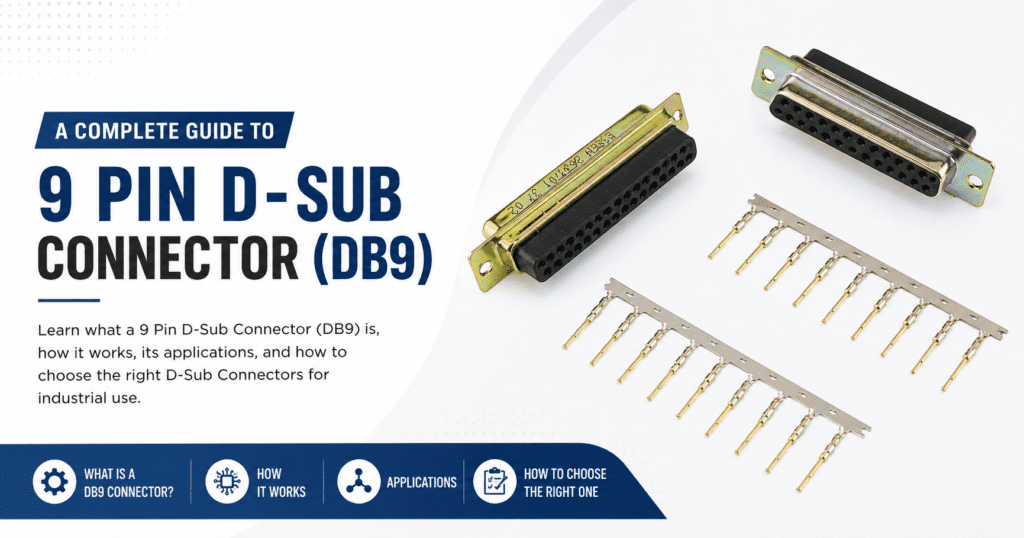
Despite the rise of modern communication interfaces, the 9 Pin D-Sub Connector continues to play an important role in industrial automation, control systems, communication equipment, and electronic devices. Its durability, reliability, and standardized design make it one of the most widely recognized connector types in the world. Understanding how D-Sub Connectors work can help engineers and buyers choose the right connectivity solution for their applications.
D-Sub Connectors remain a backbone of reliable signal and data transmission. They power serial communication, control panels, and automation systems across countless industries. This guide explains their design, working principle, pin configuration, applications, and selection tips. Engineers, OEMs, panel builders, and procurement teams will find everything needed to choose with confidence.
Quick Answer: What is a 9 Pin D-Sub Connector?
Quick answer: A 9 Pin D-Sub Connector is a D-shaped electrical connector with nine pins used for signal and data communication. It is commonly called a DB9 connector. It supports serial communication standards like RS-232. You will find it in industrial automation, control panels, communication devices, test equipment, and computer peripherals worldwide.
What Are D-Sub Connectors?
D-Sub Connectors are standardized electrical connectors named for their distinctive D-shaped metal shell. The “D” shape prevents incorrect mating and improves shielding.
These connectors come in different pin counts, such as 9, 15, 25, 37, and 50. The 9 pin version, known as the DB9 connector, is among the most popular for serial communication.
D-Sub Connectors were introduced in the 1950s and quickly became an industry standard. Today, they remain trusted electronic connectors for industrial and commercial use.
Key reasons engineers rely on these industrial connectors include:
- Strong mechanical design and long service life
- Reliable signal transmission in noisy environments
- Easy mating and unmating with secure locking
- Wide availability in many configurations
Understanding the Structure of a 9 Pin D-Sub Connector
The structure of a 9 Pin D-Sub Connector is simple yet robust. Each part plays a role in performance and durability.
A typical DB9 connector includes:
- Metal shell: A D-shaped housing that shields against electromagnetic interference.
- Insulator body: Holds the pins in place and prevents short circuits.
- Contacts: Nine pins or sockets that carry signals and data.
- Mounting hardware: Screws or clips that secure the connector to panels or cables.
The shell shape ensures correct orientation every time. This foolproof design reduces wiring errors during installation.
Key Features of a 9 Pin D-Sub Connector
| Feature | Description |
| Number of Pins | 9 pins (male) or 9 sockets (female) |
| Connector Type | D-shaped D-Sub (DB9) connector |
| Communication Purpose | Serial communication, signal and data transfer |
| Mounting Style | Panel mount, PCB mount, and cable mount options |
| Durability | Rugged metal shell built for harsh industrial use |
| Industrial Applications | Automation, control panels, telecom, test equipment |
| Signal Transmission | Reliable, low-noise transfer with EMI shielding |
How Does a 9 Pin D-Sub Connector Work?
A 9 Pin D-Sub Connector works by linking two devices through matched pins and sockets. Each pin carries a specific signal between the connected equipment.
When the male and female connectors mate, the pins align inside the sockets. This creates a secure electrical path for data and control signals.
The connector often supports RS-232 serial communication. In RS-232, separate pins handle transmit, receive, ground, and control functions. This division keeps signals clean and reduces interference.
The metal shell grounds the connection and blocks external noise. As a result, these serial communication connectors stay reliable even in electrically noisy factories.
Pin Configuration of a DB9 Connector
The pin configuration of a DB9 connector follows the RS-232 standard in most applications. Understanding each pin helps with wiring and troubleshooting.
Here is a common RS-232 layout for a 9 pin D-sub connector:
- Pin 1 – DCD: Data Carrier Detect
- Pin 2 – RXD: Receive Data
- Pin 3 – TXD: Transmit Data
- Pin 4 – DTR: Data Terminal Ready
- Pin 5 – GND: Signal Ground
- Pin 6 – DSR: Data Set Ready
- Pin 7 – RTS: Request To Send
- Pin 8 – CTS: Clear To Send
- Pin 9 – RI: Ring Indicator
Signal transmission basics
Each pin carries one signal type. Transmit and receive pins move data, while control pins manage the flow. The ground pin provides a stable reference for all signals.
RS-232 communication relevance
RS-232 is a long-standing serial standard. The DB9 connector became its default interface. Many PLCs, CNC machines, and instruments still use this method today.
Male vs female connector configurations
Male connectors have exposed pins. Female connectors have sockets. Devices that send data often use male connectors, while ports usually use female ones. Always confirm gender before ordering a D-sub cable connector.
Practical industrial use cases
Engineers use DB9 connectors to link sensors, controllers, drives, and computers. They are common in equipment that needs stable, low-speed data links.
Common Applications of 9 Pin D-Sub Connectors
The 9 Pin D-Sub Connector serves many industries. Its reliability makes it a default choice for industrial communication connectors.
Common Applications of D-Sub Connectors
| Industry/Application | Purpose |
| Industrial Automation | Connect PLCs, drives, and controllers for serial data |
| Control Panels | Route signals between panel devices and field equipment |
| CNC Machines | Transfer programs and control data to machine tools |
| Telecommunications | Link communication equipment and network hardware |
| Test Equipment | Connect oscilloscopes, meters, and diagnostic tools |
| Medical Equipment | Carry control and data signals in monitoring devices |
| Security Systems | Connect access control and surveillance components |
| Data Communication | Enable serial links between computers and peripherals |
These control panel connectors handle the steady signal needs of industrial electronics. From CNC machines to security systems, they keep critical data flowing.
Advantages of Using D-Sub Connectors
D-Sub Connectors offer clear benefits for industrial and commercial systems. These advantages explain their long-running popularity.
- Proven reliability: Decades of use prove their dependable performance.
- Strong durability: Metal shells resist shock, vibration, and wear.
- EMI shielding: The shell blocks noise for clean data transmission.
- Foolproof design: The D-shape prevents incorrect connections.
- Wide availability: Many pin counts and mounting styles exist.
- Easy maintenance: Screw locks make replacement simple and secure.
- Cost-effective: They deliver long life at a reasonable price.
For mission-critical systems, these signal connectors reduce downtime and support costs.
Types of D-Sub Connectors Available
There are several D-sub connector types to match different needs. Choosing the right one depends on your application and environment.
Common variations include:
- By pin count: 9, 15, 25, 37, and 50 contacts.
- By density: Standard density and high density layouts.
- By gender: Male (pins) and female (sockets).
- By mounting: Panel mount D-Sub connector, PCB mount, and cable mount.
- By contact style: Solder, crimp, and IDC ribbon cable options.
Essen Deinki manufactures a full range of these connectors, including the M Series, 863 Series, IDL Series, and C Series. Each series targets specific industrial conditions, from harsh environments to compact PCB designs.
9 Pin D-Sub Connector vs Modern Communication Interfaces
Modern interfaces like USB, Ethernet, and HDMI offer high speeds. Yet the DB9 connector still wins in many industrial settings. The table below compares them.
| Factor | 9 Pin D-Sub (DB9) | USB | Ethernet | HDMI |
| Reliability | Very high in noisy areas | Moderate | High | Moderate |
| Industrial usage | Extremely common | Growing | Common | Rare |
| Durability | Rugged metal shell | Lighter plastic | Moderate | Lighter |
| Compatibility | Legacy and current PLCs | Modern devices | Networked systems | Display devices |
| Long-term support | Decades of support | Frequent changes | Ongoing | Ongoing |
USB and Ethernet suit fast, modern data needs. The 9 Pin D-Sub Connector suits stable, long-life serial links. For legacy machines and rugged plants, it remains the safer choice.
How to Choose the Right D-Sub Connector
Choosing the right connector avoids costly mistakes. Match the connector to your exact application needs.
Consider these factors before buying:
- ✓Number of pins required for your signals
- ✓Mounting method (panel, PCB, or cable)
- ✓Operating environment and temperature range
- ✓Shielding requirements for EMI protection
- ✓Connector gender (male or female)
- ✓Cable compatibility with your wiring
- ✓Communication protocol such as RS-232
- ✓Durability requirements for vibration and wear
- ✓Industrial standards compliance like UL94V-O
- ✓Long-term reliability for critical systems
Choose a high density connector if space is tight but pin counts are high. Choose a rugged sealed series if oil, water, or dust are present.
Before Purchasing a D-Sub Connector, Check These Factors
Use this quick checklist for procurement and engineering teams:
- ☐ Confirmed correct pin count and gender
- ☐ Verified mounting style fits the panel or PCB
- ☐ Checked contact plating for conductivity needs
- ☐ Matched the connector to the communication protocol
- ☐ Reviewed temperature and environmental ratings
- ☐ Confirmed EMI shielding requirements
- ☐ Checked compliance with industrial standards
- ☐ Selected a trusted supplier for consistent quality
Common Mistakes to Avoid When Buying D-Sub Connectors
Small errors during selection can cause big problems later. Avoid these common mistakes.
- Wrong gender: Ordering pins instead of sockets stalls projects.
- Incorrect pin count: Too few pins limits future signals.
- Ignoring environment: Standard parts fail in oily or wet areas.
- Skipping shielding: Poor shielding causes data errors.
- Overlooking mounting: A mismatched mount wastes panel space.
- Choosing cheap quality: Low-grade connectors increase downtime.
Working with an experienced supplier helps you avoid these pitfalls and choose with confidence.
Why Choose Essen Deinki for D-Sub Connectors?
Essen Deinki is a trusted manufacturer of industrial connectivity solutions in India. The company has built electronic components since 1964, bringing 60 years of engineering expertise to every product.
With over 10,000 square meters of production space across three centres in Chandigarh and a presence in 15 countries, Essen Deinki delivers precision parts worldwide. Its D-Sub Connectors feature flame-retardant materials, gold-plated contacts, and rugged metal shells.
Engineers choose Essen Deinki for:
- Precision-engineered reliability in harsh environments
- UL94V-O flame-retardant materials for safety
- A full range of pin counts and mounting styles
- Custom configurations for specialized applications
- Strong engineering support and technical guidance
Whether you need DB9 connectors for serial communication or rugged industrial connectors for automation, Essen Deinki offers proven quality you can trust.
Make the Right Connector Choice With Confidence
The 9 Pin D-Sub Connector remains a dependable choice for serial communication, automation, and industrial electronics. Its rugged design, foolproof shape, and EMI shielding keep critical signals flowing. While modern interfaces handle high-speed tasks, D-Sub Connectors still lead where reliability and long-term support matter most.
Match the connector to your pin count, environment, mounting style, and protocol. When you do, you reduce downtime and protect your systems for years.
Ready to upgrade your connectivity? Explore high-quality D-Sub Connectors from Essen Deinki. Contact Essen Deinki today for expert connector selection assistance and technical support for your application.
Frequently Asked Questions (FAQs)
What is the purpose of a 9 Pin D-Sub Connector?
A 9 Pin D-Sub Connector transfers signals and data between devices. It mainly supports serial communication, such as RS-232. Engineers use it to link PLCs, CNC machines, controllers, and computers. Its rugged design and EMI shielding make it reliable for industrial automation and communication systems.
Is a DB9 connector the same as a 9 Pin D-Sub Connector?
Yes, a DB9 connector and a 9 Pin D-Sub Connector are the same component. “DB9” is the common nickname for the 9 pin version of these D-Sub Connectors. Both terms describe a D-shaped connector with nine pins used for serial communication and signal transfer.
Where are D-Sub Connectors commonly used?
D-Sub Connectors are common in industrial automation, control panels, CNC machines, and telecommunications. You also find them in test equipment, medical devices, and security systems. Their reliable signal transmission and durable design make them a trusted choice across many industrial and electronic applications.
Where can I buy reliable D-Sub Connectors in India?
You can buy reliable D-Sub Connectors in India from Essen Deinki. The company manufactures DB9 and other industrial connectors with proven quality since 1964. Essen Deinki offers many configurations, custom options, and strong engineering support to match your exact application needs.