

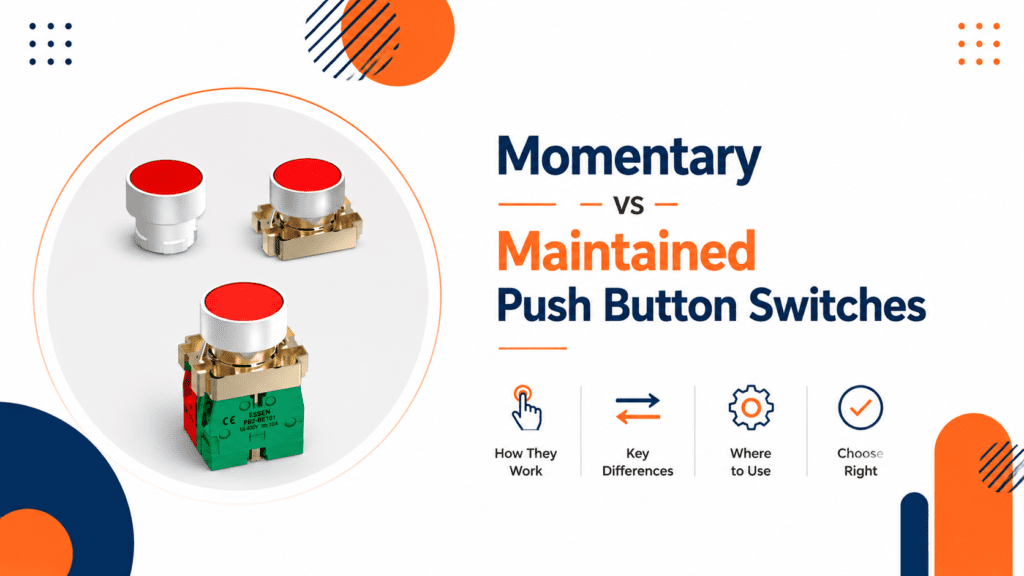
Push button switches are among the most widely used control devices in industrial and commercial electrical systems. However, many engineers and buyers are unsure whether a momentary or maintained switch is the right choice for their application. Understanding the differences between these two Push Button Switches can help improve safety, efficiency, and equipment performance.
The choice between these two switch types affects everything from machine startup to emergency response. A wrong selection can lead to safety risks, operational delays, or even equipment damage. This guide breaks down how each type works, where it fits, and how to pick the right one.
Whether you build control panels, maintain plant machinery, or source components for OEM equipment, this article gives you clear, practical guidance. Let’s explore what sets these switches apart.
Quick Answer: What is the Difference Between Momentary and Maintained Push Button Switches?
Quick answer: Momentary push button switches return to their original position the moment you release them, sending a signal only while pressed. Maintained push button switches stay in their selected position after release and change only when pressed again or manually reset. Momentary switches suit start and jog functions. Maintained switches suit on/off and emergency stop applications.
What Are Push Button Switches?
Push Button Switches are manual control devices that open or close an electrical circuit when pressed. They are core components in industrial control panels and machine control systems.
These switches act as the link between an operator and a machine. A simple press can start a motor, stop a conveyor, or trigger an emergency shutdown.
Most industrial push button switches use NO and NC contacts:
- NO (Normally Open): The circuit stays open until the button is pressed.
- NC (Normally Closed): The circuit stays closed until the button is pressed.
You’ll find these electrical switching devices in manufacturing plants, automation systems, switchgear assemblies, and OEM machinery. They are valued for their reliability, simple operation, and long service life.
How Does a Momentary Push Button Switch Work?
A momentary push button switch activates only while you hold it down. The instant you release it, an internal spring returns the button to its resting position.
This means the switch sends a signal for a short, controlled moment. Once released, the circuit returns to its default state.
Think of a doorbell. It rings only while pressed and stops the moment you let go. The same principle drives most machine start buttons.
Momentary switches are ideal when an action needs precise, temporary control. They are widely used in push button control systems where safety and accuracy matter.
How Does a Maintained Push Button Switch Work?
A maintained push button switch holds its position after you press it. It stays in that state until you press it again or reset it manually.
This makes it a true on/off control. One press turns a function on. A second press turns it off.
A common example is a light switch. Press once to switch the light on, press again to switch it off. The switch “remembers” its last state.
Maintained switches are perfect for functions that must stay active without continuous pressing. This includes power isolation and many panel mounted switches.
Momentary vs Maintained Push Button Switches: Key Differences
The table below compares both switch types across the factors that matter most in industrial applications.
| Feature | Momentary Switch | Maintained Switch |
| Operating Method | Active only while pressed | Stays active after one press |
| State After Release | Returns to original position | Holds selected position |
| Common Applications | Machine start, jog, reset | On/off control, emergency stop |
| User Interaction | Continuous or repeated press | Single press to change state |
| Safety Considerations | Stops action when released | Locks state until reset |
| Energy Usage | Signals briefly | Signals as long as engaged |
| Control Function | Temporary control | Latched control |
Both types serve different control needs. The right choice depends entirely on the function you want to achieve.
Common Industrial Applications of Momentary Push Button Switches
Momentary switches handle tasks that need short, controlled signals. They are common across many machine control systems.
Typical push button switch applications include:
- Machine start buttons on production lines.
- Jog or inch controls for precise motor movement.
- Reset buttons for alarms and fault clearing.
- Doorbell and signaling functions in facilities.
- Test buttons used during maintenance checks.
These switches give operators direct, real-time control. The action stops the moment the button is released, which improves safety.
Common Industrial Applications of Maintained Push Button Switches
Maintained switches suit functions that must stay on or off without constant pressing. They are essential in control panel switches and power systems.
Common applications include:
- Power on/off control for machines and panels.
- Emergency stop switches that latch until reset.
- Lighting control in plants and workshops.
- Mode selection in industrial automation switches.
- Equipment isolation during maintenance.
The latching action provides clear, stable control. Operators can see and confirm the switch state at a glance.
Application Requirement vs Recommended Switch Type
Use this quick reference to match common functions with the right Push Button Switches.
| Application Requirement | Recommended Switch Type |
| Machine Start Function | Momentary Switch |
| Emergency Stop | Maintained Switch |
| Conveyor Control | Momentary Switch |
| Lighting Control | Maintained Switch |
| Industrial Automation | Both (function dependent) |
| Panel Controls | Both (function dependent) |
| Motor Operation | Momentary Switch |
This guide helps engineers and procurement teams select faster and avoid costly mistakes.
Advantages and Limitations of Each Switch Type
Each switch type brings clear strengths and a few trade-offs. Knowing both helps you make a confident choice.
Momentary Push Button Switch
Advantages:
- Improves safety with temporary, controlled actions.
- Ideal for precise machine operations.
- Prevents accidental continuous operation.
Limitations:
- Requires continuous pressing for ongoing tasks.
- Not suited for simple on/off functions.
Maintained Push Button Switch
Advantages:
- Holds its state without constant pressing.
- Clear visual indication of on/off status.
- Perfect for latched and isolation functions.
Limitations:
- Needs manual reset to change state.
- Less suited for quick, repeated actions.
Momentary vs Maintained Push Button Switches: Which Is Better?
There is no universally better option. The best switch depends on your specific application.
Choose a momentary push button switch if temporary control and operator safety matter most. It works well for start, jog, and reset functions.
Choose a maintained push button switch if you need a stable on/off state. It suits emergency stops, isolation, and lighting control.
Your decision should balance these factors:
- Safety requirements of the machine or process.
- Operational efficiency and ease of use.
- User convenience for daily operators.
- Industry standards like IEC/EN-60947-5-1.
The right match improves both performance and safety on the floor.
Real-World Applications of Push Button Switches
Push Button Switches appear in nearly every industrial setting. Here’s how different sectors use them daily.
- Manufacturing plants: Start and stop controls on production machinery.
- Process industries: Mode selection and emergency stops on control panels.
- Packaging machinery: Jog controls for precise alignment.
- Material handling systems: Conveyor start and stop functions.
- Power distribution systems: Isolation and switching controls.
- Industrial automation systems: Integrated controls for automated lines.
- OEM equipment: Built-in operator controls for custom machines.
These examples show why reliable industrial push button switches are critical to smooth operations.
How to Choose the Right Push Button Switch for Your Application
Selecting the correct switch starts with understanding your function. Then match the switch features to your operating conditions.
Use this buyer’s checklist to guide your decision:
- ✓Application type: Start, stop, jog, or isolation.
- ✓Voltage rating: Must match your control circuit.
- ✓Current rating: Suited to the connected load.
- ✓Contact configuration: NO, NC, or changeover.
- ✓Mounting requirements: Panel size and fit.
- ✓Environmental protection rating: Dust and moisture resistance.
- ✓Operating frequency: How often the switch is used.
- ✓Safety requirements: Emergency stop or standard control.
- ✓Industrial standards compliance: IEC/EN-60947-5-1.
- ✓Long-term reliability: Service life and build quality.
Working through this list helps you avoid mismatched components and future failures.
Important Technical Factors to Consider Before Buying
Beyond the basic checklist, a few technical details deserve close attention. These factors affect long-term performance.
- Contact material and durability: Determines switching life and reliability.
- Vibration and shock resistance: Vital for heavy machinery environments.
- IP protection rating: Protects against dust, water, and contaminants.
- Modular design: Simplifies installation, upgrades, and maintenance.
- Terminal protection: Shrouded terminals guard against electrical shock.
For example, Essen Deinki’s PB7 Series offers a modular, shock-resistant design that conforms to IEC/EN-60947-5-1. The PB2 Series adds self-wiping contacts and shrouded terminals for extended life and safety.
Why Choose Essen Deinki for Push Button Switches?
Essen Deinki is a trusted manufacturer of industrial electrical components in India. The company has delivered precision components since 1964, backed by 60 years of engineering expertise.
With over 10,000 square meters of production space across three centers in Chandigarh and a presence in 15 countries, Essen Deinki combines scale with quality.
Their Push Button Switches include the PB7 and PB2 Series, designed for control panels, signaling stations, and machinery. Key strengths include:
- Modular, customizable designs.
- Shock and vibration resistance.
- Compliance with IEC/EN-60947-5-1 standards.
- UL/CSA-compliant testing and government-approved R&D.
For reliable industrial push button switches backed by decades of expertise, Essen Deinki is a preferred source in India.
Get Expert Guidance from Essen Deinki — contact their team today for help selecting the right switch for your application.
Conclusion
Choosing between momentary and maintained Push Button Switches comes down to one question: does your function need temporary or latched control?
Momentary switches return to their resting state on release, making them ideal for start, jog, and reset tasks. Maintained switches hold their position, making them perfect for on/off control, isolation, and emergency stops.
By matching the switch type to your application, voltage, contact configuration, and safety needs, you ensure better performance and longer equipment life.
For high-quality control panel switches and expert technical support, reach out to Essen Deinki. Find the Right Industrial Switch for Your Application — Contact Essen Deinki Today.
Frequently Asked Questions (FAQs)
What are Push Button Switches used for?
Push Button Switches are used to control electrical circuits in industrial and commercial systems. They start and stop machines, trigger emergency stops, control lighting, and operate conveyors. These switches are essential components in control panels, automation systems, and OEM machinery across many industries.
What is the main difference between momentary and maintained switches?
A momentary switch returns to its original position the moment you release it, signaling only while pressed. A maintained switch holds its position after release and changes only when pressed again or reset. Momentary suits start functions, while maintained suits on/off and emergency stop controls.
Which switch type is commonly used in industrial control panels?
Both types appear in industrial control panels. Momentary switches handle start, jog, and reset functions. Maintained switches manage on/off control, emergency stops, and equipment isolation. The exact choice depends on the specific control function, safety requirements, and operational needs of the machine.
Where can I buy reliable Push Button Switches in India?
You can buy reliable Push Button Switches in India from Essen Deinki, a trusted manufacturer since 1964. Their PB7 and PB2 Series offer modular designs, vibration resistance, and IEC/EN-60947-5-1 compliance. Contact Essen Deinki for product selection assistance and expert technical guidance.