

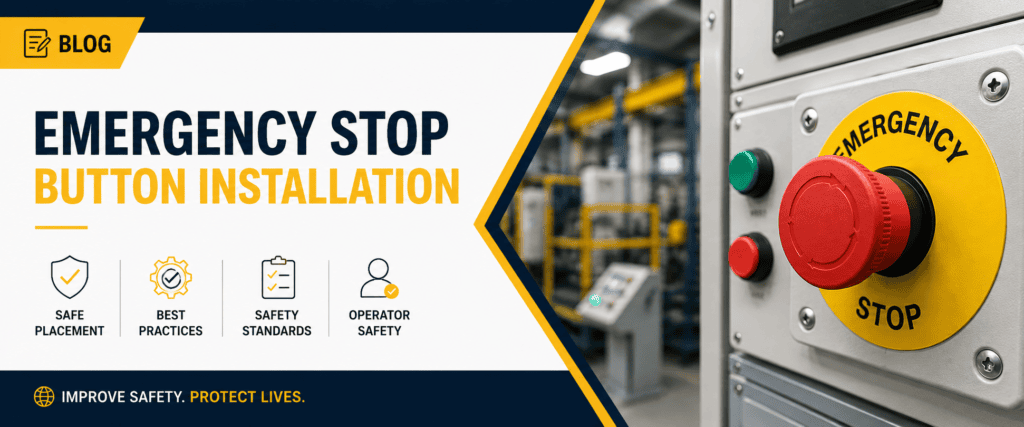
Emergency Stop Buttons should be installed near the machine operator, at control panels, at machine entry and exit points, along conveyor systems, and near hazardous zones. For large machinery, multiple stop points are required. Each location must be clearly visible, unobstructed, and reachable within seconds to ensure effective emergency machine shutdown.
In an industrial emergency, every second matters. An Emergency Stop Button allows operators to stop machinery immediately, helping reduce the risk of injuries, equipment damage, and production losses. However, installing the button in the wrong location can delay response time and compromise workplace safety. Understanding where Emergency Stop Buttons should be installed is essential for creating a safer and more efficient work environment.
Whether you manage a manufacturing plant, operate automated production lines, or design industrial control panels, correct placement of Emergency Stop Switches is one of the most important decisions in machine safety. This guide walks you through the right locations, key installation factors, common mistakes, and best practices—so your facility stays protected.
What Is an Emergency Stop Button?
An Emergency Stop Button (also called an Emergency Push Button or Emergency Shutdown Switch) is a safety control device designed to halt machinery instantly during a dangerous situation.
When activated, it cuts power to the machine or triggers a controlled shutdown sequence. Most Emergency Stop Buttons feature a mushroom-head actuator in red on a yellow background—making them easy to identify under pressure. A turn-to-release or key-release mechanism prevents accidental restarts.
These devices are a core part of industrial safety equipment, used across factories, automation lines, packaging units, and heavy machinery operations. Without them, operators have no reliable way to stop a machine quickly when things go wrong.
Where Should Emergency Stop Buttons Be Installed?
Placement directly determines how quickly an operator can respond in a crisis. Here are the primary locations recommended for installing Industrial Emergency Stop Buttons:
Near the Machine Operator
The most critical location is within immediate reach of the person controlling the machine. The operator should never have to move more than one or two steps to activate the Emergency Stop Switch. Delayed access increases injury risk significantly.
At Operator Control Panels
Every industrial control panel should include at least one Emergency Push Button. This ensures the operator can stop the machine without leaving their workstation—essential during fast-moving or high-risk operations.
At Machine Entry and Exit Points
Workers approaching or leaving a machine must have access to a stop function. Installing Emergency Stop Buttons at entry and exit points allows personnel to initiate an emergency machine shutdown before entering a hazardous zone—or while exiting quickly.
Along Conveyor Systems
Long conveyor lines require multiple Emergency Stop Switches placed at regular intervals. If a jam, entrapment, or mechanical failure occurs at any point along the conveyor, the nearest button must be within fast reach. Industry practice typically recommends placements every 10 to 15 metres along the line.
Near Hazardous Machinery
Cutting machines, presses, robotic arms, and other high-risk equipment demand Emergency Stop Buttons directly adjacent to the hazard zone. The faster the machine can cause harm, the closer the stop function needs to be.
Multiple Locations for Large Machines
Large industrial machines with several operating zones must have Emergency Stop Buttons at each zone. A single button at one end of a large machine is insufficient—it could take too long to reach during an emergency at the other end.
| Installation Location | Why It Matters |
| Operator Control Panel | Immediate access during operation |
| Machine Entry Point | Quick shutdown before approaching hazards |
| Machine Exit Point | Easy access when leaving the work area |
| Conveyor Systems | Rapid emergency response along long equipment |
| Hazardous Zones | Faster reaction during critical situations |
| Large Machinery | Multiple stop points improve accessibility |
What Factors Should You Consider Before Installing Emergency Stop Buttons?
Getting the location right requires more than guesswork. These factors should guide every installation decision:
Operator Accessibility
The button must be reachable without bending, stretching, or moving around obstacles. Accessibility is non-negotiable—any delay in reaching an Emergency Stop Button can result in serious injury.
Visibility
Operators and safety personnel must spot the button instantly. A red mushroom-head actuator on a yellow background is the internationally recognised standard. Poor lighting or cluttered environments can reduce visibility and slow response time.
Ergonomic Placement
Mounting height matters. Buttons placed too high or too low create delays. A height between 0.6 metres and 1.7 metres from the floor is widely recommended, though specific requirements may vary based on machine design and operator posture.
Machine Size and Layout
Larger machines and complex layouts require more stop points. A thorough review of the machine footprint and operating zones will reveal where additional Emergency Stop Switches are needed.
Risk Assessment
Conduct a formal risk assessment before finalising locations. Identify the highest-risk zones, the likely positions of operators during normal and abnormal operations, and the speed at which a hazard could develop.
Environmental Conditions
Dust, moisture, vibration, and extreme temperatures affect the performance of Electrical Safety Devices. Choose Emergency Stop Buttons with an appropriate IP (Ingress Protection) rating for the operating environment.
| Installation Factor | Best Practice |
| Visibility | Clearly visible from operating position |
| Accessibility | Reachable without obstruction |
| Mounting Height | Comfortable for operators |
| Maintenance | Inspect and test regularly |
| Environment | Select suitable protection rating |
| Identification | Clearly labelled and easy to recognise |
What Are the Most Common Emergency Stop Button Placement Mistakes?
Even experienced engineers make placement errors. Here are the mistakes most likely to compromise safety:
- Hidden or obstructed buttons: A button placed behind a panel, pillar, or piece of equipment may be invisible during an emergency.
- Too few stop points: Installing only one Emergency Stop Switch on a machine with multiple operating zones creates dangerous gaps in coverage.
- Incorrect mounting height: Buttons mounted too high for shorter operators, or too low to be seen quickly, increase response time.
- No maintenance schedule: Emergency Stop Buttons that are never tested may fail when needed most. Regular functional testing is essential.
- Missing identification: Buttons without clear labelling or standard colour coding can be confused with other Push Button Switches on the control panel.
- Ignoring environmental factors: Using a standard button in a high-moisture or dusty environment without the correct IP rating leads to premature failure.
Avoiding these mistakes is just as important as choosing the right locations in the first place.
Which Industry Standards Apply to Emergency Stop Button Installation?
Recognised international standards provide clear guidance on Machine Safety Switch design, placement, and performance. Two of the most widely referenced are:
ISO 9001:2015— This standard defines the design principles for Emergency Stop functions on machinery. It specifies performance requirements, including response characteristics and reset mechanisms.
IEC 60947-5-1— This standard covers the safety of machinery as it relates to electrical equipment, including requirements for Emergency Shutdown Switch design and placement in Safety Control Systems.
These standards are widely adopted in industrial automation safety, manufacturing safety, and machinery design across India and globally. Following them improves workplace safety, reduces liability, and supports better outcomes during audits and compliance reviews.
Always consult a qualified safety engineer or refer to the applicable standards when designing or reviewing your factory safety systems.
What Are the Benefits of Correct Emergency Stop Button Placement?
Proper placement of Industrial Emergency Stop Buttons delivers measurable improvements across the operation:
- Faster emergency response: Operators reach the button in seconds, not minutes—reducing the severity of incidents.
- Reduced injury risk: Quick machine shutdown limits exposure to moving parts, electrical hazards, and other dangers.
- Equipment protection: Faster stops reduce the chance of secondary damage to machinery and tooling.
- Less unplanned downtime: Controlled shutdowns prevent cascading failures that lead to extended production stoppages.
- Improved operator confidence: Workers who know they can stop a machine instantly feel safer and perform better.
- Stronger safety culture: Visible, well-placed Machine Emergency Controls signal that the organisation takes safety seriously.
How Do You Choose High-Quality Emergency Stop Buttons?
Not all Emergency Stop Buttons perform equally. When selecting industrial safety equipment, consider the following:
- Build quality: Look for robust housings that withstand vibration, impact, and harsh conditions.
- Reliability: Self-wiping contacts and reliable actuation mechanisms ensure consistent performance over millions of operations.
- Visibility: High-visibility actuators in red on yellow improve recognition speed under stress.
- Durability: Industrial-grade components rated for long mechanical and electrical lifespans reduce replacement frequency.
- Standard compliance: Choose products that comply with IEC 60947 and other applicable standards to ensure your safety systems meet recognised performance benchmarks.
- Configuration flexibility: Select buttons available in flush, projecting, or mushroom-head designs to suit different control panel and machinery requirements.
Why Choose Essen Deinki for Industrial Emergency Stop Buttons?
Essen Deinki has been manufacturing precision electrical components since 1964. With over 10,000 square metres of production space across three centres in Chandigarh and a presence in 15 countries, Essen Deinki combines six decades of engineering expertise with rigorous quality standards.
The Emergency Stop Buttons from Essen Deinki—including the PB5 Series—are engineered for demanding industrial environments. Key features include:
- High-visibility mushroom-head actuators for instant identification
- Shrouded terminals to protect against electrical shocks
- Up to 3 million mechanical operations lifespan for long-term reliability
- Multiple configurations including flush, projecting, and mushroom-head designs
- Compliance with IEC and EN 60947 standards
- 22.5mm cut-out compatibility for straightforward panel integration
From packaging machinery and conveyor systems to heavy industrial automation, Essen Deinki’s Industrial Emergency Stop Button range supports a wide variety of applications. Their turn-to-release functionality ensures systems remain secure before restarting—an important safeguard in any production environment.
Placing Emergency Stop Buttons Correctly Saves Lives
The correct installation of Emergency Stop Buttons is not a minor technical detail—it is a fundamental element of any machine safety strategy. Every second saved in an emergency translates directly into reduced injury risk, less equipment damage, and faster recovery of production.
Start with a thorough risk assessment. Map operator positions, identify hazardous zones, and plan stop points for every area where a person could be at risk. Follow ISO 9001:2015and IEC 60947-5-1as your baseline. Choose industrial-grade Emergency Stop Switches designed to perform reliably in your specific environment. And test them regularly—a button that fails in an emergency provides no protection at all.
As Indian industry continues to modernise and adopt advanced industrial automation safety practices, the quality and placement of Emergency Push Buttons will remain a defining factor in how well facilities protect their people and assets.
Frequently Asked Questions (FAQs)
How many Emergency Stop Buttons does a machine need?
The number depends on machine size, layout, and the number of operating zones. A small single-operator machine may require one button. Large machines or conveyor systems require multiple Emergency Stop Buttons placed at each operator station, entry point, exit point, and hazardous zone.
What is the correct mounting height for an Emergency Stop Button?
A mounting height between 0.6 metres and 1.7 metres from the floor is widely recommended. The exact height should consider operator posture, accessibility, and ergonomic reach during normal and emergency conditions.
What standards govern Emergency Stop Button installation in India?
ISO 9001:2015and IEC 60947-5-1are the most widely referenced international standards for Emergency Stop functions and machine electrical safety. These standards provide guidance on design, placement, and performance requirements for machine safety systems.
How often should Emergency Stop Switches be tested?
Emergency Stop Switches should be tested as part of regular maintenance schedules—typically during planned maintenance shutdowns or at intervals specified in the machine’s safety documentation. Functional testing confirms that the button activates correctly and triggers the intended shutdown response.
Looking for reliable Emergency Stop Buttons for your industrial applications? Contact Essen Deinki today for expert guidance and high-quality industrial electrical components designed to enhance machine safety, reliability, and operational efficiency.