

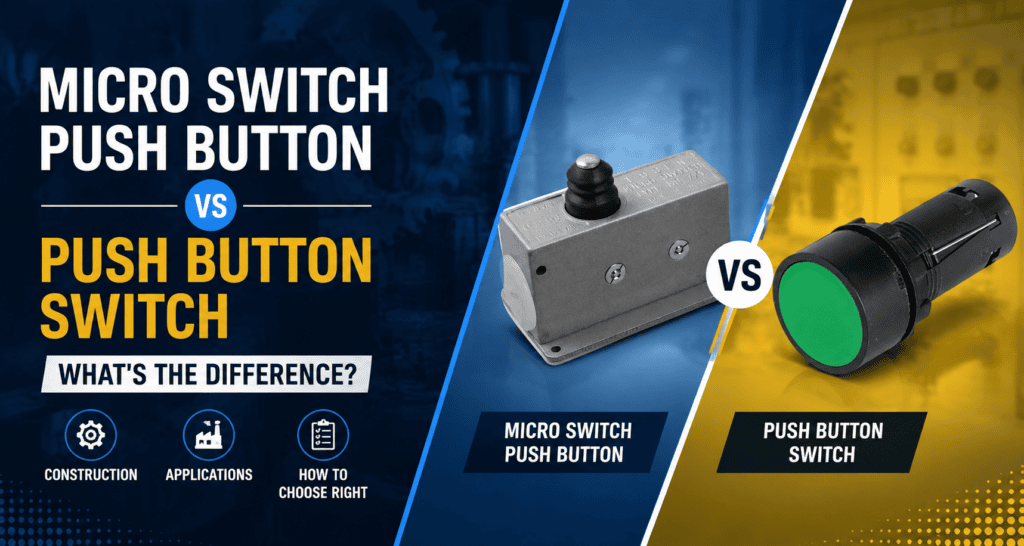
Quick Answer: A micro switch push button uses a precise internal snap-action mechanism to switch circuits with minimal actuation force, making it ideal for high-precision applications. A push button switch is a broader category of electrical control switch used to start, stop, or control circuits in industrial panels and automation systems. Both are essential control panel components, but they serve distinct purposes.
Selecting the correct switch is essential for the safety, efficiency, and reliability of any electrical or industrial automation system. Although micro switch push buttons and push button switches may appear similar at first glance, they are designed for different functions and applications. Understanding these differences helps engineers and buyers choose the right component for long-term performance.
This guide breaks down both switch types—covering construction, working principles, applications, and selection criteria—so you can make a confident, informed decision for your next project.
What Is a Push Button Switch?
A push button switch is an electromechanical device that opens or closes a circuit when an operator applies direct physical pressure. It is one of the most widely used electrical control switches in industrial and commercial settings.
When a user presses the button, the internal contact mechanism either completes or breaks the circuit. Most industrial push button switches are available in momentary (spring-return) or latching (maintained contact) configurations, depending on the application requirement.
The main components of a push button switch include the actuator, contact block, housing, and terminal connectors. The actuator is available in various styles—flush, extended, mushroom head, or illuminated—to suit different control panel designs.
Common industrial applications include:
- Motor start/stop control
- Conveyor and packaging machine control
- Emergency stop (E-stop) circuits
- Process control panels
- Machine tool operation
What Is a Micro Switch Push Button?
A micro switch push button is a precision switching device that uses a snap-action internal mechanism to achieve fast, reliable circuit switching. The term “micro switch” refers to the internal snap-action contact mechanism, not necessarily the physical size of the device.
The snap-action mechanism operates using a pre-loaded spring that trips rapidly once a defined actuation force threshold is crossed. This delivers consistent, repeatable switching with very low operating travel. As a result, micro switch push buttons offer exceptional switching accuracy and long mechanical life.
Micro switch push buttons are commonly found in applications where precise detection, repeatability, and fast response are critical. They are widely used in:
- Limit sensing and position detection
- Safety interlocks and door guards
- Precision testing equipment
- Appliances and consumer electronics
- Automated assembly and inspection systems
Micro Switch Push Button vs Push Button Switch: Key Differences Every Industrial Buyer Should Know
While both devices control electrical circuits through physical actuation, several differences distinguish them in construction, performance, and application suitability.
Construction: A push button switch uses a direct-contact mechanism that completes or breaks the circuit when the button is fully pressed. A micro switch push button uses a snap-action internal mechanism, meaning the circuit switches at a precisely defined pre-travel point—not necessarily at full button depression.
Operating Mechanism: Push button switches typically require full or near-full mechanical travel to actuate. Micro switch push buttons trip at a specific pre-determined actuation point with minimal force, offering greater control in precision applications.
Switching Accuracy: Micro switch push buttons deliver consistent trip-point repeatability, which is critical in sensing and safety applications. Standard push button switches prioritize reliable manual control rather than precision trip-point accuracy.
Durability: Industrial push button switches like the Essen Deinki PB7 and PB2 Series are built for heavy-duty industrial environments, with shock and vibration resistance, IP-rated enclosures, and compliance with IEC/EN-60947-5-1 standards. Micro switch push buttons also offer high mechanical life but are more suited to controlled environments where precision matters most.
Response Time: Micro switch push buttons switch faster due to the snap-action mechanism. Push button switches have a slightly longer response time based on operator actuation speed.
Cost Considerations: Standard industrial push button switches are generally more cost-effective for high-volume panel builds. Micro switch push buttons carry a premium due to their precision snap-action mechanism.
Comparison Table: Micro Switch Push Button vs Push Button Switch
| Feature | Micro Switch Push Button | Push Button Switch |
| Construction | Snap-action internal mechanism | Direct-contact actuator mechanism |
| Working Method | Trips at pre-defined actuation point | Actuates on full or near-full button press |
| Applications | Sensing, interlocks, precision detection | Motor control, panel operation, E-stop |
| Switching Precision | High — consistent trip-point repeatability | Standard — manual control focused |
| Mounting | Panel mount, inline, lever-actuated | Panel mount, modular, DIN rail compatible |
| Durability | High mechanical life in controlled environments | High — built for industrial environments |
| Switching Speed | Very fast (snap-action) | Dependent on operator actuation speed |
| Cost | Higher due to precision mechanism | Cost-effective for industrial panel builds |
Where Is a Push Button Switch Used in Industrial Applications?
Push button switches are among the most versatile control panel components across virtually every industry sector. Understanding these applications helps procurement managers and panel builders specify the right device from the outset.
Industrial Automation: Push button switches initiate and stop automated sequences on production lines. They provide operators with direct, reliable control over machinery without complex interfaces.
Manufacturing and Machine Tools: Machine tools rely on push button switches for spindle start/stop, coolant control, and axis operation. Their robust construction handles constant operator interaction across multi-shift production environments.
Control Panels and Signaling Stations: Electrical control panels in process industries, energy management systems, and building automation all use push button switches to manage operational commands and alarm acknowledgment.
Packaging and Material Handling: Conveyor systems, sortation equipment, and packaging machines use momentary push button switches for jog control, product feed, and emergency stopping.
Process Industries: Chemical, pharmaceutical, and food processing plants rely on IP-rated push button switches that resist dust, moisture, and aggressive cleaning chemicals—making compliance with environmental protection ratings a non-negotiable specification.
When Should You Choose a Micro Switch Push Button?
Micro switch push buttons are the right choice when your application demands precise actuation, fast response, and consistent repeatability over millions of operating cycles.
Choose a micro switch push button when you need to detect the position of a moving component, gate, or safety guard at a precise point. Safety interlock systems on machine enclosures frequently use micro switch push buttons because they need reliable, repeatable activation every time a door opens or closes.
They are also preferable in testing and inspection equipment, where the switch must consistently deliver the same electrical response regardless of operator force variation. If your application involves light-touch sensing rather than deliberate manual operation, a micro switch push button is the appropriate selection.
For general-purpose industrial automation, motor control, and operator interface panels, a standard industrial push button switch remains the more practical and cost-effective solution.
Factors to Consider Before Buying a Push Button Switch
Selecting the correct push button switch requires evaluating several technical and environmental criteria. Rushing this decision leads to premature failure, compliance gaps, and costly downtime.
| Buying Factor | Why It Matters |
| Voltage Rating | Ensures safe operation within your system’s electrical parameters |
| Current Rating | Prevents contact overload and premature wear |
| IP Rating | Protects internal contacts from dust, moisture, and contaminants |
| Mounting Style | Simplifies installation and ensures panel compatibility |
| Material Quality | Improves durability in high-temperature or chemical environments |
| Operating Life | Reduces maintenance frequency and long-term replacement costs |
Voltage and Current Rating: Always specify a switch rated for the voltage and current levels in your control circuit. Undersized ratings cause contact welding and circuit failures.
IP Rating: Outdoor, washdown, or dusty environments require push button switches with IP65 or higher protection. Essen Deinki’s industrial push button switches meet IEC/EN-60947-5-1 standards, making them suitable for demanding industrial conditions.
Operating Cycles: High-frequency applications demand switches with high mechanical and electrical life ratings. Confirm the operating cycle specification before finalizing your selection.
Compliance Standards: For regulated industries such as pharmaceuticals, food processing, and energy, verify that your chosen switch complies with relevant national and international standards, including IEC, CE, and UL/CSA requirements where applicable.
Why Choose Essen Deinki for Industrial Push Button Switches?
Essen Deinki has been manufacturing precision industrial electrical components since 1964—bringing over 60 years of engineering expertise to every product. Based in Chandigarh, India, with a global presence across 15 countries and 10,000+ square meters of production space, Essen Deinki is a trusted name among industrial buyers, OEMs, and panel builders.
The Essen Deinki Push Button Switch range includes the PB7 Series and PB2 Series, both engineered to IEC/EN-60947-5-1 standards. The PB7 Series delivers modular, shock-resistant performance for demanding industrial environments. The PB2 Series combines compact design with self-wiping contacts, making it ideal for space-constrained control panels.
Every Essen Deinki switch undergoes rigorous quality assurance through government-approved R&D and UL/CSA-compliant testing processes. From technical consultation to after-sales support, the Essen Deinki team provides end-to-end assistance to help you select the right component for your specific application.
Make the Right Switch Selection Every Time
Micro switch push buttons and push button switches are both essential components in modern electrical and industrial automation systems—but they are not interchangeable. Micro switch push buttons deliver snap-action precision for sensing, detection, and safety interlock applications. Push button switches provide robust, reliable manual control for industrial panels, machine tools, and automation systems.
Understanding these distinctions protects your equipment, ensures compliance, and reduces long-term maintenance costs. Choosing the right push button switch from the outset is always more cost-effective than correcting a misspecified installation.
For expert guidance on selecting the right industrial push button switch for your project, reach out to the Essen Deinki technical team today.
Need Help Choosing the Right Push Button Switch?
Contact Essen Deinki Today
📍 22, Industrial Area, Phase II, Chandigarh – 160002
📞 +91 0172-2653111–115
📧info@essendeinki.com
Explore Push Button Switches →
Frequently Asked Questions (FAQs)
What is the main difference between a micro switch push button and a push button switch?
A micro switch push button uses a snap-action internal mechanism that trips at a precise actuation point. A push button switch operates through direct manual contact actuation. Micro switch push buttons prioritize precision; push button switches prioritize robust manual circuit control.
Where are push button switches most commonly used in industrial settings?
Push button switches are widely used in motor start/stop control, industrial control panels, packaging machinery, conveyor systems, and emergency stop circuits. They are fundamental control panel components in manufacturing, process industries, and automation systems throughout India and globally.
How do I select the right push button switch for my application?
Evaluate the voltage rating, current rating, IP protection level, mounting style, operating cycle requirements, and applicable compliance standards. For complex or high-frequency applications, consult a specialist supplier like Essen Deinki for application-specific recommendations.
Can micro switch push buttons replace standard push button switches in control panels?
Not typically. Micro switch push buttons are optimized for precision sensing and detection tasks, not heavy-duty manual operator control. Standard industrial push button switches are better suited for control panel applications where operators directly initiate commands.