

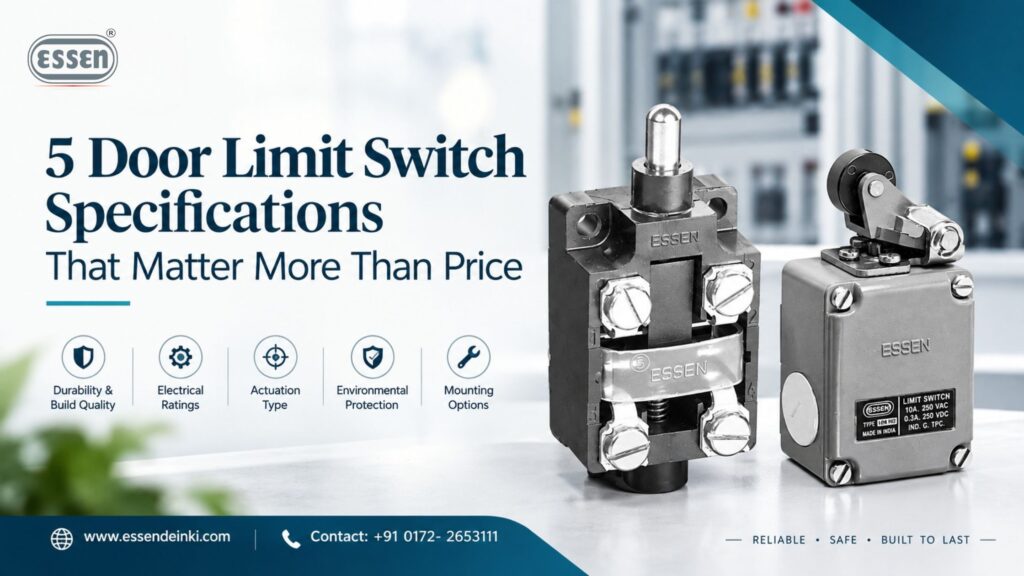
Quick answer: When selecting Door Limit Switches for industrial applications, buyers should prioritize electrical rating, IP rating, mechanical life, actuator/mounting compatibility, and environmental suitability over upfront price. Ignoring these specifications often leads to premature failure, safety risks, and higher long-term maintenance costs than the initial savings justify.
Procurement teams under pressure to cut costs often default to the lowest quoted price when sourcing Door Limit Switches. It’s an understandable instinct — budgets are tight, and a switch is a switch, right? Not quite.
Door Limit Switches are small components with an outsized impact on machine safety and uptime. A switch that fails prematurely on a factory safety door, an elevator, or a packaging line doesn’t just cost the price of a replacement part. It can trigger unplanned downtime, safety interlocks that stop production, and even compliance issues on regulated equipment.
For electrical engineers, maintenance teams, and OEMs sourcing components in India’s competitive industrial market, understanding what actually differentiates one Door Limit Switch from another is far more valuable than comparing quotations line by line. This article breaks down the five specifications that matter most, explains why each one affects reliability and safety, and offers practical guidance on what to check before you buy.
What Are Door Limit Switches and Where Are They Used?
Door Limit Switches are electromechanical position-sensing devices that detect whether a door, panel, or access point is open or closed. When the door interacts with the switch actuator, the internal contacts change state, sending a signal to the control system.
These switches are widely used in:
- Industrial safety doors and machine guarding enclosures
- Control panels and electrical cabinets
- Elevators and lifts
- Packaging machinery with access panels
- Conveyor system guards
- CNC machine enclosures
In most of these applications, the Door Limit Switch isn’t just a convenience feature — it’s often part of a safety interlock circuit. That’s exactly why specification quality matters more than sticker price.
5 Door Limit Switch Specifications That Matter More Than Price
Choosing Door Limit Switches based on the lowest bid without reviewing these five specifications is one of the most common (and costly) mistakes in industrial procurement. Here’s what to evaluate instead.
1. Electrical Rating and Switching Capacity
Why does electrical rating matter when selecting a limit switch? The electrical rating determines whether a Door Limit Switch can safely handle the voltage and current present in your circuit without degrading or failing.
Electrical rating refers to the maximum voltage and current a switch’s contacts can handle without excessive wear, arcing, or failure. Door Limit Switches are typically rated in AC and DC configurations — for instance, a switch might be rated for 10 A at 500V AC or 0.4 A at 440V DC (non-inductive load).
What buyers should check:
- Whether the switch’s AC and DC ratings match your actual circuit load, not just the nominal panel voltage
- Contact configuration (such as 1 NO + 1 NC, or 2 NO + 2 NC) required for your control logic
- Whether the load is inductive or non-inductive, since inductive loads cause more contact wear over time
If a Door Limit Switch is undersized for the electrical load, contacts can pit, weld shut, or burn out well before the manufacturer’s stated cycle life. This directly affects safety interlock reliability — a switch that fails to open when it should is a serious hazard on a guarded door circuit.
2. IP Rating and Protection Against Environmental Conditions
Why is IP rating important for industrial limit switches? The Ingress Protection (IP) rating indicates how well a switch is sealed against dust, moisture, and liquids — factors that directly determine whether it survives in a factory environment.
An IP rating (such as IP65 or IP67) is a standardized measure of a switch’s resistance to solid particles and water ingress. The first digit indicates dust protection; the second indicates moisture protection.
What buyers should check:
- Whether the manufacturing environment involves dust, washdown cycles, coolant spray, or humidity
- Whether the switch housing is diecast, sealed with a gasket, or open execution (open execution switches offer minimal environmental protection)
- Compatibility between the IP rating and the specific zone where the door or panel is located (indoor cabinet vs. outdoor equipment, for example)
A switch with an inadequate IP rating installed in a dusty or humid environment can suffer from internal corrosion, contact contamination, or moisture ingress — all of which lead to erratic switching behavior or complete failure. This is one of the most overlooked reasons for premature limit switch replacement in Indian manufacturing facilities, where ambient conditions vary widely across regions and seasons.
3. Mechanical Life and Durability
How does mechanical life affect a limit switch? Mechanical life indicates how many switching cycles a Door Limit Switch can perform before mechanical wear affects its accuracy or function, directly influencing replacement frequency and maintenance planning.
Mechanical life is typically expressed as a number of switching cycles — for example, many industrial-grade limit switches are rated for up to 15,000,000 switching cycles under normal operating conditions. Contact life (the number of cycles under actual electrical load) is usually lower than pure mechanical life, since electrical wear accelerates degradation.
What buyers should check:
- The manufacturer’s stated mechanical and contact life figures, and whether they were tested under conditions similar to your application
- Switching frequency requirements — some applications demand switches capable of operating at up to 3,000 cycles per hour
- Whether the switch uses a snap-action mechanism, which is generally designed to reduce contact arcing and extend electrical life compared to slow-action designs
Buyers who choose a Door Limit Switch based purely on price often overlook mechanical life ratings entirely. In high-cycle applications like packaging lines or conveyor systems, a lower-rated switch may need replacing several times over the lifespan of a higher-spec alternative, making the “cheaper” option more expensive over time.
4. Actuator Type, Operating Mechanism, and Mounting
The actuator is the physical component that triggers the switch — a roller lever, plunger, or rotary mechanism, for instance. Choosing the right actuator type and mounting configuration is fundamental to reliable performance.
What buyers should check:
- Whether the application requires a roller lever (for continuous or multi-directional movement), a plunger type (for compact, direct-contact applications), or a rotary mechanism (common in hoists and cranes)
- Actuating force requirements — some designs require as little as 0.75 kg of force, while others tolerate up to 1.5 kg
- Physical mounting dimensions and housing type, since a mismatch between actuator design and door movement pattern can cause misalignment, incomplete actuation, or mechanical stress
- Whether roller lever switches need multi-directional operation (some designs allow actuation from four directions in 90° increments)
Choosing an actuator that doesn’t match the door’s motion path is a common and costly error. A switch may be electrically sound and have excellent mechanical life, but if the actuator can’t engage properly with the door’s travel pattern, false triggers, incomplete signals, or physical damage to the lever can result.
5. Environmental and Operating Conditions
How should environmental conditions influence switch selection? Environmental conditions — including temperature, humidity, vibration, and exposure to chemicals — should directly determine which Door Limit Switch materials and housing types are suitable for a given installation.
Most industrial limit switches are designed for operation within a specified ambient temperature and humidity range — commonly up to 50°C and 85% relative humidity. Operating outside this range without a switch rated for it can affect insulation resistance, contact reliability, and housing integrity.
What buyers should check:
- Ambient temperature extremes at the installation site, including seasonal variation
- Exposure to vibration (common in conveyor and material handling equipment)
- Presence of chemicals, oils, or coolants that could degrade housing materials
- Dielectric strength and insulation resistance specifications, particularly in electrically noisy environments
Selecting a Door Limit Switch without matching it to the operating environment often shows up months later as intermittent faults that are difficult to diagnose — exactly the kind of downtime that erases any savings from a lower purchase price.
Comparison Table: What to Check Before Buying Door Limit Switches
| Specification | What to Check | Why It Matters | Risk of Ignoring It |
| Electrical Rating | AC/DC voltage and current rating, contact configuration, load type | Ensures the switch handles your circuit’s actual load without degrading | Contact welding, arcing, or premature electrical failure |
| IP Rating | Dust and moisture protection level, housing type (open vs. sealed diecast) | Protects internal components from environmental contamination | Corrosion, erratic switching, moisture-related failure |
| Mechanical Life | Rated switching cycles, snap-action vs. slow-action mechanism | Determines how long the switch performs reliably before wear affects accuracy | Frequent replacements, unplanned downtime |
| Actuator & Mounting | Actuator type (roller, plunger, rotary), actuating force, mounting dimensions | Ensures proper engagement with door movement pattern | False triggers, incomplete actuation, mechanical damage |
| Environmental Conditions | Temperature/humidity range, vibration exposure, chemical resistance | Confirms suitability for the actual installation site | Intermittent faults, insulation breakdown, reduced service life |
Price vs. Total Value: What Should Industrial Buyers Consider?
A lower-priced Door Limit Switch can look attractive on a purchase order, but the real cost of a component includes far more than its invoice price. Buyers should weigh:
- Downtime cost: A failed limit switch on a safety door circuit can halt an entire production line until it’s replaced.
- Replacement frequency: A switch with lower mechanical life or inadequate IP rating may need replacing multiple times over the same period a higher-spec switch lasts once.
- Compatibility costs: An actuator or mounting mismatch may require rework, custom brackets, or wiring modifications.
- Safety and compliance risk: On interlocked safety doors, a switch failure isn’t just inconvenient — it can create a genuine hazard.
Choose a lower-cost switch if your application involves low cycle counts, a controlled indoor environment, and non-critical signaling. Choose a switch with stronger specifications across electrical rating, IP protection, and mechanical life if the application involves safety interlocking, harsh environments, or high-frequency operation — the total cost of ownership will typically favor the better-specified component.
How to Choose the Right Door Limit Switch for Your Application
Selecting the right Door Limit Switch comes down to matching the five specifications above to your specific use case:
- Identify the electrical load and circuit voltage/current.
- Assess the environment — dust, moisture, temperature, and chemical exposure.
- Estimate expected switching frequency and required mechanical life.
- Determine the actuator type and mounting configuration needed for the door’s movement.
- Confirm environmental operating limits match your facility conditions.
Working through these factors systematically, rather than defaulting to the lowest quote, results in a component that performs reliably over its intended service life.
Why Consider Essen Deinki for Limit Switch Requirements?
Essen Deinki has manufactured electronic and electromechanical components, including limit switches, microswitches, and connectors, since 1964, with production facilities in Chandigarh spanning over 10,000 square meters and a presence across 15 countries.
Essen Deinki’s limit switch range includes roller lever, plunger, and snap-action designs with configurations such as 1 NO + 1 NC and 2 NO + 2 NC contact arrangements, electrical ratings up to 10 A at 500V AC, and mechanical life ratings of up to 15,000,000 switching cycles under typical conditions. Housing options include open execution and diecast aluminum alloy enclosures, giving buyers flexibility depending on environmental protection needs.
If your application involves matching electrical load, IP protection, mechanical durability, actuator type, and environmental conditions to a suitable Door Limit Switch, it’s worth reviewing the Essen Deinki limit switch range to compare specifications against your requirements.
Frequently Asked Questions
1. What is the most important specification to check before buying Door Limit Switches?
There isn’t a single “most important” specification — electrical rating, IP protection, mechanical life, actuator compatibility, and environmental suitability all interact. The right priority depends on your specific application, such as switching frequency or exposure to moisture.
2. Can a cheaper Door Limit Switch still be reliable?
Yes, if its specifications genuinely match the application’s electrical load, environment, and cycle requirements. The issue isn’t price itself — it’s buying without verifying whether the specifications fit the intended use.
3. How often should Door Limit Switches be replaced?
Replacement frequency depends on mechanical and contact life ratings, switching frequency, and environmental exposure. A switch rated for 15,000,000 cycles will generally outlast one with a lower rating under the same operating conditions.
4. What happens if the IP rating is not suitable for the installation environment?
An inadequate IP rating can allow dust or moisture into the switch housing, leading to contact contamination, corrosion, or erratic operation — often resulting in unplanned downtime or safety interlock failures.
Get Help Selecting the Right Door Limit Switch
Choosing Door Limit Switches based on specifications rather than price alone helps reduce downtime, maintenance costs, and safety risks over the life of your equipment. If you’re evaluating options for a specific application, Essen Deinki’s team can help match electrical, mechanical, environmental, and mounting requirements to a suitable switch. Contact Essen Deinki to discuss your Door Limit Switch requirements.