

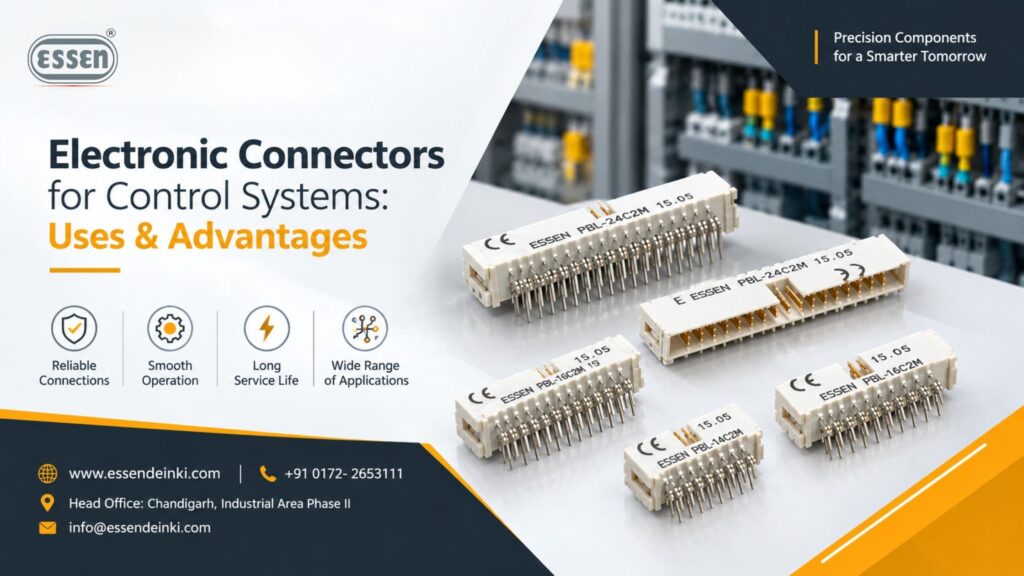
Quick answer: Electronic connectors join wires, cables, or circuit boards to establish reliable electrical and signal connections within control systems. Control panels, PLC-based systems, sensors, and automation equipment use them to transmit power and data safely. Choosing the right electronic connectors improves installation efficiency, wiring organization, and long-term system reliability.
Control systems depend on thousands of individual connections working together without interruption. From a single sensor feeding data to a PLC to a control panel distributing power across an entire production line, every link in that chain matters. Electronic connectors make these links possible, and their selection directly influences how well a control system performs over its lifetime.
For electrical engineers, control system designers, panel builders, and procurement managers, understanding electronic connectors is essential. The right connector supports reliable operation, while a poor choice can cause downtime, signal errors, or safety risks.
This article explains what electronic connectors are and how they support control systems. It also covers common types, advantages, and selection factors. Whether you’re designing a new control panel or sourcing components for an existing automation project, this guide offers practical insights to support your decision-making.
What Are Electronic Connectors?
Electronic connectors join electrical or electronic circuits and allow current or signals to pass from one point to another. They typically consist of a housing, contacts, and sometimes a locking or latching mechanism that keeps the connection secure during operation.
In control systems, electronic connectors act as the physical interface between wires, cables, circuit boards, and devices. Instead of permanently soldering every connection, technicians can connect, disconnect, and reconnect components as needed. This makes assembly, testing, and maintenance far more manageable.
The Role of Electronic Connectors in Control Systems
Control systems rely on a continuous flow of electrical power and data between components such as controllers, sensors, actuators, and displays. Electronic connectors sit at each junction point in this network, ensuring that power and signals reach their intended destination without interruption.
In practical terms, electronic connectors in control systems help to:
- Establish electrical continuity between components.
- Maintain signal integrity for data and communication lines.
- Allow modular assembly and disassembly of control panels.
- Support quick replacement of faulty components without rewiring entire circuits.
Control systems often operate continuously in demanding industrial environments. Therefore, their connectors need to maintain stable connections despite vibration, temperature fluctuations, and regular handling during maintenance.
Why Reliable Connections Matter in Industrial Control Applications
A control system is only as dependable as its weakest connection. A loose or poorly rated connector can lead to intermittent faults, signal loss, or even complete system failure. These issues can disrupt production and increase maintenance costs.
This is why electronic connectors are not a minor detail in control system design. Reliable connections directly affect:
- Operational uptime: Connection failures often require troubleshooting and downtime to resolve.
- Signal accuracy: Sensors and communication protocols depend on clean signal transmission.
- Safety: Poor connections in power circuits can create electrical hazards.
- Maintenance efficiency: Well-organized connector systems are easier to inspect and service.
Actual reliability depends on several factors, including connector design, specifications, installation quality, environmental conditions, and the application. No connector guarantees flawless performance on its own. Instead, engineers must match it correctly to its intended use.
How Electronic Connectors Are Used in Control Systems
Electronic connectors appear throughout the architecture of modern control systems, supporting a wide range of functions. Common applications include the following.
Control panels: Control panels use electronic connectors to link power supplies, terminal blocks, relays, and control devices in an organized manner.
PLC-based systems: Programmable Logic Controllers rely on electronic connectors to interface with input/output modules, communication cards, and field devices.
Machine control systems: Connectors link control units to motors, drives, and actuators, enabling coordinated machine operation.
Sensors and instrumentation: Electronic connectors provide the interface between sensors and control electronics, supporting accurate data transmission for monitoring and feedback loops.
Industrial equipment: Manufacturing machinery, conveyor systems, and processing equipment use electronic connectors to simplify wiring between distributed components.
Communication and signal connections: Many control systems use electronic connectors to support communication protocols between controllers, HMIs, and networked devices.
Control cabinets: Within enclosed cabinets, electronic connectors help organize dense wiring while keeping components accessible for servicing.
Electrical and electronic assemblies: Connectors simplify assembly for manufacturers that build control equipment at scale. They also allow teams to use standardized wiring harnesses across multiple units.
Overall, electronic connectors serve the same purpose across these applications: they establish and maintain reliable electrical or signal connections between components that need to work together.
Types of Electronic Connectors Used in Control Systems
Different control applications call for different connector types. Here’s an overview of common categories relevant to industrial control environments.
Wire-to-wire connectors: These connectors join two wires or cables directly, often where teams need flexible routing between components.
Wire-to-board connectors: These connectors link a wire or cable to a printed circuit board. They commonly serve applications where field wiring needs to interface with control electronics.
Board-to-board connectors: These connectors join two PCBs directly, often in compact control modules or stacked electronic assemblies.
Terminal connectors: These connectors provide a secure termination point for wires. Control panels and terminal blocks often use them to distribute power or signals.
Circular connectors: These connectors offer a robust, often environmentally sealed connection. They suit applications where vibration or moisture may be present.
D-sub connectors: These connectors commonly support data and communication interfaces, particularly where multiple signal lines need to share a single connection point.
Signal connectors: These connectors help preserve signal quality where data integrity is a priority, such as in sensor and instrumentation wiring.
Industrial connectors: Manufacturers build these connectors for durability in demanding environments. They often feature robust housings and secure locking mechanisms.
Ultimately, the right choice depends on the specific application, its electrical requirements, physical constraints, and environmental conditions. Essen Deinki’s electronic connectors range, including the P-Series and PBL Profile Series, offers configurations for different contact counts, mounting styles, and latch options.
How Connector Design Affects Signal and Electrical Connection Reliability
Electronic connector design directly affects performance in a control system. Consider these important design elements.
- Contact material and plating: Engineers often choose gold-plated contacts to improve conductivity and resist corrosion. This can support more consistent signal quality over time.
- Housing material: Flame-retardant, solvent-resistant thermoplastic housings help connectors withstand harsh industrial conditions without degrading.
- Locking mechanisms: Polarized designs and latching options reduce the risk of accidental disconnection. This feature is particularly important in equipment subject to vibration.
- Contact spacing: Precise terminal spacing supports accurate alignment and reduces the chance of misconnection during assembly.
These design factors do not guarantee performance on their own. However, they influence how a connector behaves under real operating conditions. Discuss them with your supplier before finalizing a design.
Key Advantages of Using Suitable Electronic Connectors
When engineers match electronic connectors to an application, the connectors offer several practical advantages for control system design, installation, and maintenance.
- Reliable electrical connections: Properly selected connectors support consistent current and signal flow across the system.
- Secure signal transmission: Quality connectors help minimize signal loss or interference, particularly in sensor and communication circuits.
- Easier installation: Standardized connectors allow technicians to assemble control panels and wiring harnesses more efficiently than manual soldering.
- Easier maintenance: Connectors enable quick disconnection and reconnection, simplifying troubleshooting and component replacement.
- Organized wiring: Connectors with defined contact counts and layouts help keep control cabinets tidy and easier to inspect.
- Simplified assembly: Manufacturers can pre-assemble wiring harnesses and connect them during final assembly, reducing production time.
- Flexible system configuration: Modular connectors make it easier to modify or expand a control system as requirements change.
- Reduced wiring complexity: In systems with many components, connectors help consolidate multiple wires into manageable connection points.
- Easier replacement or servicing: Technicians can often replace faulty components without disturbing the surrounding wiring.
- Better component integration: Connectors provide a standardized interface, making it easier to integrate devices from different manufacturers.
Keep expectations realistic: no connector is maintenance-free or guaranteed never to fail. Actual performance depends on the connector’s design, its specifications for the application, installation quality, and operating environment. Therefore, choose electronic connectors that genuinely suit your system to improve the chances of consistent performance.
How Electronic Connectors Support Easier Installation and Maintenance
Beyond day-to-day operation, electronic connectors affect how efficiently teams can build and service a control system throughout its lifetime.
During installation, technicians can plug pre-terminated wiring harnesses into place instead of wiring them on-site. This can reduce assembly time and wiring errors. The benefit is especially valuable for machine manufacturers producing multiple units, where consistent, repeatable wiring saves time at scale.
Similarly, during maintenance, technicians can isolate and test individual sections of a control system without disconnecting the entire wiring loom. If a sensor or module needs replacement, they can often unplug it and install the new component at the connector. This approach reduces downtime and the risk of wiring mistakes during repairs.
How to Choose the Right Electronic Connectors for Control Systems
Selecting electronic connectors involves more than finding a part that physically fits. Engineers and procurement teams should evaluate several factors to ensure reliable performance in the intended application.
Electrical Requirements
- Application requirements: Understand the specific function the connector will serve, such as power distribution, signal transmission, or data communication.
- Number of contacts: Confirm the connector provides enough contacts for the required connections, with some allowance for future expansion if relevant.
- Current rating: Ensure the connector can safely handle the electrical load of the circuit.
- Voltage rating: Match the connector’s voltage rating to the system’s requirements for safe integration.
- Signal requirements: For data or communication lines, consider connectors designed to preserve signal quality.
Physical and Environmental Requirements
- Connector size: Factor in available space within control panels or equipment enclosures.
- Mounting method: Decide between options such as panel mount, PCB mount, or cable mount based on the design.
- Connection type: Consider whether a wire-to-wire, wire-to-board, or board-to-board connector suits the application.
- Environmental conditions: Account for exposure to dust, moisture, chemicals, or vibration in the installation environment.
- Temperature requirements: Confirm the connector is rated for the expected operating temperature range.
- Vibration and mechanical conditions: In equipment subject to movement or shock, choose connectors with secure locking features.
- Protection requirements: Where relevant, check whether the application requires connectors with a specific ingress protection rating.
Installation and Maintenance Considerations
- Material and construction: Review housing and contact materials for durability and compatibility with the environment.
- Compatibility with existing components: Ensure new connectors integrate smoothly with existing wiring and equipment.
- Ease of installation and maintenance: Favor connector designs that simplify assembly and future servicing.
- Manufacturer specifications: Always verify ratings and compatibility against the manufacturer’s official documentation before finalizing a selection.
Specifications vary between connector types and manufacturers. Therefore, confirm exact ratings with your supplier before finalizing a design. Check current capacity, voltage rating, and temperature range.
Common Mistakes to Avoid When Selecting Electronic Connectors
However, even experienced teams can run into issues when choosing electronic connectors for control systems. Some common mistakes include:
- Selecting based only on price: The cheapest connector isn’t always the most cost-effective choice if it leads to premature failure or compatibility issues.
- Ignoring electrical ratings: Overlooking current or voltage ratings can result in overheating or unreliable performance.
- Choosing an incompatible connector type: Mismatched connector types can complicate assembly or compromise the connection.
- Overlooking environmental conditions: A connector that performs well in a controlled environment may not hold up in a dusty, humid, or high-vibration setting.
- Not considering installation requirements: Difficult-to-install connectors can slow down assembly and increase labor costs.
- Ignoring future maintenance needs: Choosing connectors without considering ease of servicing can make future repairs more time-consuming.
- Failing to verify manufacturer specifications: Relying on assumptions rather than confirmed datasheets can lead to mismatched expectations about performance.
Avoiding these pitfalls starts with treating connector selection as an engineering decision, not just a procurement line item.
Electronic Connector Selection Factors at a Glance
| Selection Factor | Why It Matters in Control Systems |
|---|---|
| Contact Count | Determines how many electrical or signal connections the connector can accommodate |
| Current Rating | Helps ensure the connector suits the required electrical load |
| Voltage Rating | Supports safe and appropriate system integration |
| Connector Type | Determines compatibility with the application |
| Mounting Method | Affects installation and system design |
| Environmental Conditions | Helps determine suitability for the operating environment |
| Size | Matters when control-panel or equipment space is limited |
| Maintenance Requirements | Can affect accessibility and long-term servicing |
Why Choosing the Right Connector Matters for Long-Term Performance
Ultimately, selecting the correct electronic connectors isn’t just about getting a system running today. It also affects how that system performs for years to come. A well-matched connector reduces the likelihood of connection-related faults, supports easier troubleshooting, and simplifies future upgrades or component replacements.
On the other hand, a poorly matched connector can create recurring issues, including intermittent faults, signal degradation, or difficulty sourcing compatible replacement parts. For control panel builders, machine manufacturers, and system integrators, long-term performance matters just as much as initial cost or availability.
Sourcing Electronic Connectors for Your Control System
Essen Deinki has manufactured electronic components, including connectors, microswitches, and electro-mechanical devices, since 1964. The company operates three facilities in Chandigarh, with over 10,000 square meters of production space, and serves customers in 15 countries. Its government-approved R&D and UL/CSA-compliant testing support its industrial manufacturing capabilities.
The company’s electronic connectors range includes the P-Series and PBL Profile Series for engineers, OEMs, and system integrators working on industrial and electronic applications. These connectors feature selectively gold-plated contacts, polarized designs with latch options, and flame-retardant thermoplastic construction. Customers can choose contact counts, plating classes, and mounting configurations to suit different project requirements.
If your team is specifying electronic connectors for a new control system or replacing components in an existing one, working with an experienced manufacturer can help ensure the connectors you choose suit your application rather than offering only a generic fit.
Choosing Electronic Connectors with Confidence
Electronic connectors may seem like a small part of a larger control system, but their role in maintaining reliable electrical and signal connections makes them a critical design consideration. From control panels and PLC-based systems to sensors and industrial machinery, the right electronic connectors support smoother installation, simpler maintenance, and more dependable long-term operation.
Taking the time to evaluate application requirements, electrical ratings, environmental conditions, and manufacturer specifications pays off in fewer connection-related issues down the line. Avoiding common mistakes, such as prioritizing price over compatibility, further protects your system’s reliability.
Frequently Asked Questions
What are electronic connectors used for?
Electronic connectors join wires, cables, and circuit boards to establish reliable electrical and signal connections in control panels, PLCs, sensors, and industrial machinery.
Why are electronic connectors important in control systems?
Electronic connectors maintain consistent power and signal flow between components, directly affecting a control system’s reliability, safety, and ease of maintenance.
How do I choose the right electronic connector?
Selection depends on factors like current and voltage ratings, contact count, connector type, mounting method, and environmental conditions. Always verify specifications against manufacturer documentation.
What factors should be considered when selecting electronic connectors?
Key factors include application requirements, electrical ratings, signal needs, environmental conditions, size constraints, mounting method, and ease of installation and future maintenance.
Talk to Essen Deinki About Your Control System Requirements
Choosing the right electronic connectors can affect your control system’s performance and long-term maintenance. If you’re designing a new panel, upgrading equipment, or exploring options for your application, Essen Deinki’s team can help evaluate your requirements and identify suitable connectors. Get in touch with Essen Deinki to discuss your electronic connector needs and explore the P-Series and PBL Profile Series in more detail.