

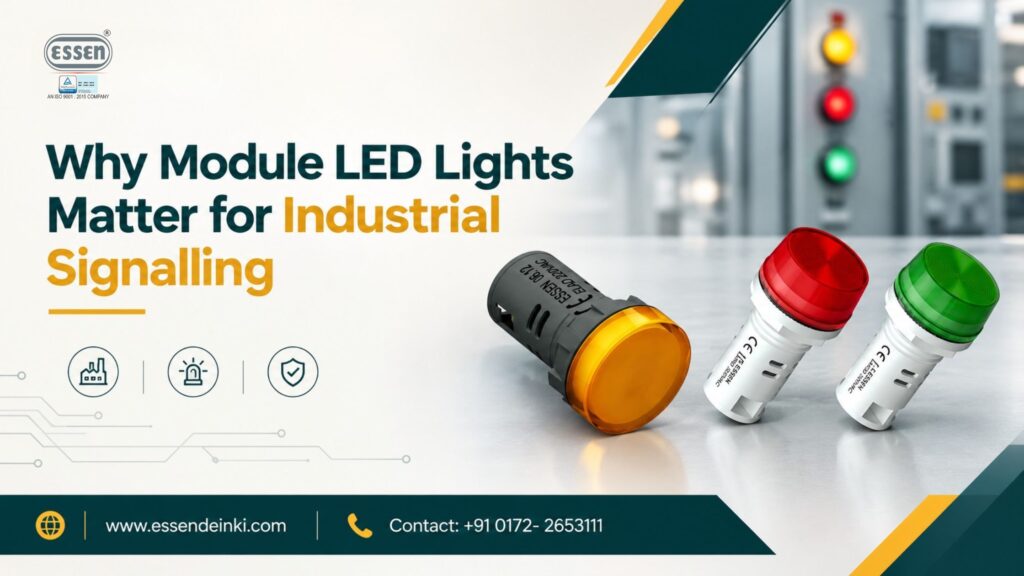
Quick answer: Module LED Lights are compact, colour-coded indicator components used in control panels and machinery to display real-time operational status. They help operators quickly identify power, fault, and process conditions, improving visibility, reducing downtime, and supporting safer decision-making on the factory floor.
Industrial facilities run on split-second decisions. When a machine stalls, a circuit trips, or a process shifts from normal to critical, operators need to know immediately — not after a costly delay. This is where Module LED Lights play a central role. As a core part of control and signalling systems, they translate complex machine conditions into simple, visible signals that anyone on the shop floor can interpret at a glance.
This article explains what Module LED Lights are, why they matter for industrial signalling, where they’re typically used, and how engineers and procurement teams can select the right ones for their application.
What Are Module LED Lights?
Module LED Lights are compact indicator components, typically installed on control panels, electrical enclosures, and machinery, designed to display a specific operational status using light and colour. Unlike general-purpose LED lighting, these modules are built for signalling — not illumination. Their purpose is communication, not brightness for its own sake.
A typical Module LED Light module consists of an LED source, a lens or cap in a specific colour, and a mounting body compatible with standard panel cutouts. This modular design allows control panel builders and machine manufacturers to integrate Module LED Lights easily into existing electrical layouts without extensive rework.
Why Visual Signalling Matters in Industrial Environments
Industrial environments are often noisy, visually busy, and physically demanding. Operators can’t always rely on sound alerts or digital screens to understand what’s happening across an entire production line. Visual signalling solves this by giving instant, unambiguous status information through colour and light — something the human eye processes faster than text or numbers.
This is precisely why Module LED Lights have become a standard feature in industrial control systems. They offer a universal visual language: green typically signals “running” or “safe,” red usually indicates “fault” or “stop,” and amber often flags a “warning” or “transitional” state. Because this colour logic is widely recognized across industries, Module LED Lights reduce the learning curve for new operators and support faster, safer responses during abnormal conditions.
How Module LED Lights Communicate Machine and System Status
Module LED Lights are typically wired into a machine’s control circuit so that a specific condition — such as power-on, motor running, or fault detected — triggers the corresponding indicator. This gives operators a continuous, real-time view of equipment status without needing to interpret data from a screen or manual.
In control panels specifically, Module LED Lights are often grouped so a single glance reveals the state of an entire system: which section is powered, which process is active, and where an issue has occurred. This kind of layered signalling is especially valuable in automation systems, where multiple processes run simultaneously and manual monitoring of each one isn’t practical.
Supporting Equipment Monitoring and Fault Indication
Beyond simple on/off status, Module LED Lights are frequently used to indicate fault conditions — such as overload, overheating, or system errors. When paired correctly with a machine’s control logic, they help maintenance teams identify problems faster, which can reduce the time spent diagnosing issues and support more efficient equipment monitoring overall.
Where Are Module LED Lights Used in Industrial Signalling?
Module LED Lights are used across a wide range of industrial signalling applications, including:
- Control panels – indicating power status, running conditions, and system faults
- Industrial machinery – displaying operational states such as start, stop, or standby
- Automation systems – signalling process stages across interconnected equipment
- Manufacturing equipment – flagging production line status and cycle completion
- Electrical panels – confirming live circuits and isolation status
- Machine status indication – showing whether equipment is idle, active, or in maintenance mode
- Fault and alarm indication – alerting operators to abnormal conditions requiring attention
- Power and status indication – confirming supply availability across systems
- Process monitoring – supporting visibility into multi-stage industrial processes
- Industrial control systems – integrating with PLCs and control logic for status feedback
These applications span sectors such as manufacturing, automotive, packaging, textiles, and process industries — anywhere machinery and control panels require reliable, at-a-glance status communication.
Key Benefits of Module LED Lights in Industrial Signalling
When correctly specified and installed, Module LED Lights offer several practical advantages for industrial operations:
- Clear visual indication of machine and system status
- Easy status identification, even from a distance or in busy environments
- Better operator awareness, supporting faster and more informed decisions
- High visibility, helping signals stand out in varied lighting conditions
- Efficient indication of multiple states through consistent colour coding
- Compact integration into control panels and industrial equipment without added bulk
- Support for machine status monitoring, aiding both operators and maintenance teams
- Reduced confusion between different operating states through standardized colour use
- Reliable visual signalling when the correct specification is matched to the application
It’s worth noting that reliability depends heavily on correct product selection and installation — no signalling component performs consistently if mismatched to its operating environment or electrical requirements.
How to Choose the Right Module LED Lights for Industrial Signalling
Selecting the right Module LED Lights isn’t just about picking a colour. Engineers and procurement teams should evaluate several factors before finalizing a purchase:
- Application type – control panel indication, machine status, or alarm signalling
- Required indication colour – aligned with standard signalling conventions for the application
- Brightness and visibility – sufficient for the ambient lighting of the installation site
- Voltage requirements – matched to the control circuit’s supply voltage
- Electrical compatibility – confirmed against the panel or machine’s wiring configuration
- Installation method – panel-mount cutout size and mounting orientation
- Panel or equipment space – available room for the module and its wiring
- Operating environment – exposure to dust, moisture, vibration, or temperature extremes
- Temperature and environmental conditions – suitability for the specific industrial setting
- Expected operating life – based on manufacturer specifications for the intended duty cycle
- Manufacturer specifications – always verified directly with the supplier before purchase
- Compatibility with the control system – integration with existing PLCs or relay logic
- Maintenance and replacement considerations – ease of servicing over the equipment’s lifetime
Because specifications such as voltage ratings, IP ratings, and lifespan figures vary by manufacturer and product line, buyers should always confirm exact technical details with the supplier before finalizing their selection.
Comparison: Key Factors in Industrial Signalling
| Factor | Why It Matters in Industrial Signalling |
| Visibility | Helps operators identify machine status quickly |
| Colour | Allows different conditions or statuses to be distinguished |
| Brightness | Supports visibility in different industrial environments |
| Voltage Compatibility | Ensures correct electrical operation |
| Installation | Determines how easily the indicator integrates into equipment |
| Operating Environment | Helps ensure suitability for actual working conditions |
| Reliability | Important for consistent status indication |
| Application | Determines the appropriate signalling solution |
Common Mistakes to Avoid When Selecting Signalling Indicators
Businesses often run into avoidable issues when choosing industrial signalling components. Common mistakes include:
- Choosing indicators based on price alone, without checking voltage or environmental compatibility
- Ignoring ambient lighting conditions, resulting in signals that are difficult to see
- Using inconsistent colour coding across different machines, causing operator confusion
- Overlooking installation space constraints, leading to panel modification delays
- Failing to confirm manufacturer specifications before bulk procurement
Avoiding these mistakes early in the selection process helps prevent rework, downtime, and unnecessary costs later.
Why Reliable Signalling Supports Safer, More Efficient Operations
Clear signalling isn’t just a convenience — it directly affects plant safety and productivity. When Module LED Lights are properly specified and installed, operators can respond faster to faults, reducing unplanned downtime. Maintenance teams can diagnose issues more efficiently, and new staff can be trained more quickly using consistent visual cues.
Because every application has different electrical, environmental, and operational requirements, businesses should choose Module LED Lights and other signalling components suited specifically to their use case, rather than applying a one-size-fits-all approach.
Sourcing Reliable Module LED Lights for Your Application
For industrial engineers, control panel builders, and procurement teams looking for dependable control and signalling components, working with an experienced manufacturer can simplify the selection process considerably. Essen Deinki’s range of control and signalling devices includes LED module pilot lights designed for industrial panel and machinery applications, alongside push button switches and other control station components.
With decades of manufacturing experience in electro-mechanical and electronic components, Essen Deinki can help engineering and procurement teams identify Module LED Lights suited to their specific voltage, environmental, and installation requirements.
Frequently Asked Questions
What are Module LED Lights used for?
Module LED Lights are used to visually indicate machine and system status — such as power-on, running, standby, or fault conditions — on control panels and industrial equipment.
Why are Module LED Lights important in industrial signalling?
They provide fast, easy-to-understand visual feedback that helps operators and maintenance teams monitor equipment status and respond quickly to faults or abnormal conditions.
Where are industrial LED signalling modules commonly used?
They’re commonly used in control panels, automation systems, manufacturing equipment, electrical panels, and industrial machinery across sectors like manufacturing, automotive, and process industries.
What should I consider when selecting Module LED Lights?
Key factors include application type, required colour, voltage compatibility, brightness, installation method, operating environment, and confirmed manufacturer specifications.
Get the Right Signalling Solution for Your Application
Choosing the right Module LED Lights comes down to matching the component to your specific electrical, environmental, and operational requirements. Getting this right supports safer, more efficient industrial operations — and getting it wrong can lead to confusion, delays, or costly rework.
If you’re an engineer, procurement manager, or control panel builder evaluating signalling options for your next project, reach out to Essen Deinki’s team to discuss your requirements and explore suitable Module LED Lights and control device solutions for your application.