

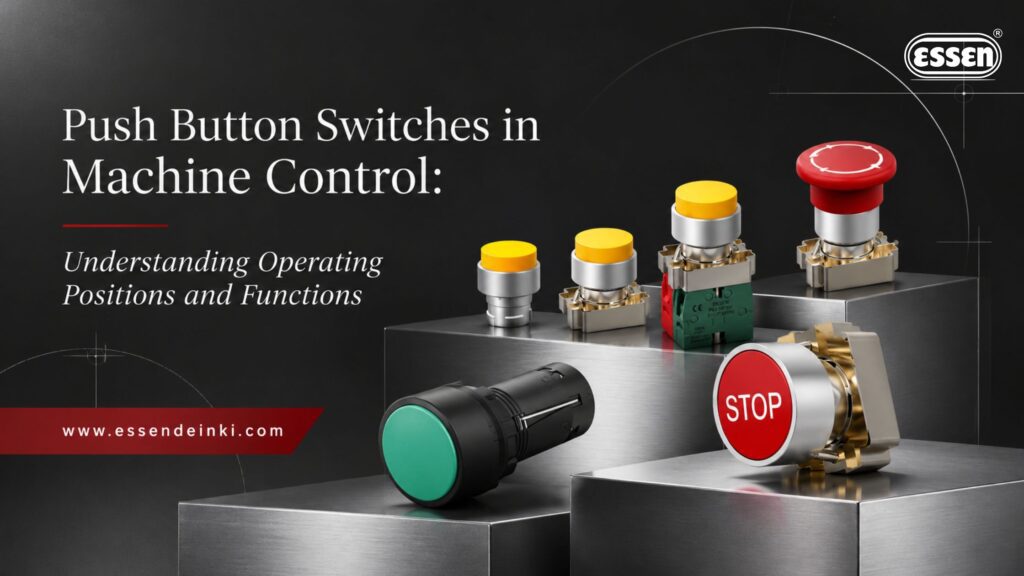
Quick answer: A push button switch is a manual control device that opens or closes an electrical circuit when pressed, enabling operators to start, stop, or reset industrial machinery. Operating positions—momentary or maintained—determine whether a machine runs only while the button is held or continues until deliberately switched off, directly affecting machine safety and control accuracy.
Industrial machines rely on dependable control components to function safely and efficiently. Among these, the push button switch remains one of the simplest yet most essential devices used across factories, control panels, and automation systems in India.
Despite their small size, push button switches play a significant role in how operators interact with machinery. From starting a conveyor belt to triggering an emergency stop, these switches translate a simple human action into a precise electrical signal.
This article explains what a push button switch is, how different operating positions work, and why selecting the right type matters for machine control. Whether you’re an electrical panel builder in Chandigarh or a maintenance engineer managing a production line, understanding these fundamentals will help you make informed decisions for your next project.
What Is a Push Button Switch and How Does It Work?
A push button switch is an electromechanical device that completes or breaks an electrical circuit when manually pressed. It typically consists of a button, a spring mechanism, and internal contacts that open or close based on the button’s position.
When an operator presses the button, the internal contacts move to either connect or disconnect the circuit. This simple mechanical action sends a signal to the connected machine, triggering a specific response such as starting a motor or stopping a process.
Because of this straightforward design, the push button switch has remained a staple in industrial automation for decades. Engineers favor it because it offers immediate, tactile control with minimal risk of accidental activation when designed correctly.
Why Operating Positions Matter in Machine Control
Operating positions refer to how a push button switch behaves once pressed—whether it returns to its original state automatically or stays engaged until manually reset. This distinction directly influences how machines respond to operator commands.
For example, a machine that should only run while a button is actively held requires a different switch type than one that needs to keep running after a single press. Choosing the wrong operating position can lead to unintended machine behavior, reduced safety, or operational inefficiencies.
As a result, understanding operating positions is critical for anyone designing or specifying control panels. Industrial automation engineers must match the switch’s function to the exact requirement of the machine process.
Momentary vs. Maintained Push Buttons: What’s the Difference?
The two primary operating functions in industrial push button switches are momentary and maintained. Each serves a distinct purpose in machine control systems.
How Does a Momentary Push Button Work?
A momentary push button switch only stays activated while pressure is applied. Once released, it springs back to its original position, breaking the circuit automatically. This function is commonly used for start buttons, jog controls, and emergency stop circuits where continuous operator engagement improves safety.
How Does a Maintained Push Button Work?
A maintained push button switch, on the other hand, stays in its activated position after being pressed. It remains engaged until the operator presses it again or performs a manual reset. This type suits applications like power-on indicators or selector functions where continuous operation is required without holding the button down.
Therefore, the choice between momentary and maintained functions depends largely on whether the machine process needs continuous operator contact or sustained activation.
Common Types of Push Button Switches Used in Industrial Machines
Industrial facilities use several types of push button switches, each designed for a specific control function. Understanding these types helps engineers and procurement managers select the correct component for their machine control switches.
Start Push Buttons
Start buttons initiate machine operations, such as powering on a motor or beginning a production cycle. They are almost always momentary, requiring the operator to press and release to trigger the action.
Stop Push Buttons
Stop buttons halt machine processes immediately. Most stop buttons use a momentary function, though critical stop circuits may incorporate maintained contacts for added control.
Reset Push Buttons
Reset buttons clear fault conditions or restore a machine to its default state after a stop or alarm event. Because reset actions are typically single commands, these buttons are usually momentary.
Emergency Stop Buttons
Emergency stop buttons are designed to immediately halt all machine functions during hazardous situations. Unlike standard stop buttons, these use a maintained, latching mechanism that keeps the circuit broken until manually released by twisting or pulling the button. This prevents machines from restarting accidentally before the hazard is addressed.
Comparison Table: Push Button Switch Types and Operating Functions
The table below compares common push button switch functions, their working principles, and typical industrial applications in machine control systems.
| Switch Type | Operating Function | Working Principle | Common Application | Key Purpose |
| Momentary Push Button | Spring return | Activates only while pressed; returns automatically on release | Start buttons, jog controls | Short, controlled activation |
| Maintained Push Button | Latching | Stays engaged after being pressed until manually reset | Power indicators, selector functions | Sustained operation without holding |
| Start Push Button | Momentary | Closes circuit briefly to initiate a process | Conveyor systems, motor starters | Begin machine operation |
| Stop Push Button | Momentary | Breaks circuit briefly to halt a process | Production lines, pumps | Pause or end machine operation |
| Reset Push Button | Momentary | Restores circuit to default state after a fault | Control panels, fault recovery systems | Clear errors and resume operation |
| Emergency Stop Button | Maintained (latching) | Locks circuit open until manually released | Heavy machinery, safety circuits | Immediate hazard response |
This comparison shows why selecting the correct operating function is just as important as choosing the right switch type. A mismatch between function and application can compromise both safety and productivity.
How Push Button Switches Support Machine Control and Automation
Push button switches act as the interface between human operators and automated systems. Because they provide direct, physical control, they remain essential even in highly automated environments.
In industrial automation setups, push button switches often work alongside programmable logic controllers (PLCs) and relay systems. For example, pressing a start button can send a signal to a PLC, which then executes a programmed sequence across multiple machine components.
Besides initiating and stopping processes, these switches also support diagnostic and safety functions. Many control panels integrate push buttons with indicator lights, allowing operators to monitor machine status at a glance while retaining manual override capability.
Factors to Consider When Selecting Industrial Push Button Switches
Choosing the right industrial push button switch involves more than picking a standard component off a shelf. Several technical and practical factors influence the decision.
Operating environment: Machines operating in dusty, humid, or vibration-prone settings require switches built to withstand these conditions without failure.
Contact configuration: Normally open (NO), normally closed (NC), or changeover (C/O) contacts determine how the switch interacts with the circuit, so this should match the control logic required.
Button size and design: Compact control panels benefit from space-saving designs, while larger installations may prioritize visibility and ease of access.
Compliance with standards: Switches conforming to international standards such as IEC/EN-60947-5-1 offer greater assurance of safety and performance consistency.
Color coding: Many industries follow color conventions, such as red for stop or emergency functions and green for start functions, to reduce operator error.
Choose a switch with shock and vibration resistance if your machinery operates in heavy manufacturing environments, since standard switches may degrade faster under constant mechanical stress.
Safety, Reliability, and Maintenance Considerations
Reliability is non-negotiable when it comes to control panel push buttons, particularly in safety-critical applications. A failed stop or emergency button can lead to serious accidents or costly downtime.
For this reason, engineers should prioritize switches with finger protection, shrouded terminals, and self-wiping contacts, as these features reduce the risk of electrical shock and extend operational lifespan. Regular maintenance checks, including testing contact responsiveness and inspecting for physical wear, further support long-term reliability.
Moreover, modular designs simplify maintenance because individual components can be replaced without overhauling the entire switch assembly. This approach minimizes downtime and keeps replacement costs manageable for industrial facilities.
Common Applications Across Indian Industries
Push button switches for industrial machines appear across a wide range of sectors in India. Manufacturing plants use them extensively on production lines, conveyor systems, and packaging equipment. Automation engineers integrate them into control panels for robotics and material handling systems.
Electrical panel builders also specify these switches for signaling stations, power distribution units, and motor control centers. In commercial electronics and facility management, maintained push buttons often control lighting systems, ventilation units, and access control mechanisms.
Given India’s growing focus on industrial automation, the demand for dependable electrical control switches continues to rise across these diverse applications.
Why Choosing the Right Switch Matters for Efficient Machine Operation
Selecting an appropriate push button switch directly affects machine performance, operator safety, and long-term maintenance costs. A poorly matched switch can cause delayed responses, inconsistent control, or premature component failure.
Therefore, machinery manufacturers and procurement managers should treat switch selection as a technical decision, not just a budgeting one. Investing in quality components upfront often reduces downtime and repair expenses over a machine’s operational life.
About Essen Deinki’s Push Button Switch Range
Essen Deinki offers industrial push button switches designed for precision, durability, and safety across various machine control applications. The company’s PB7 Series features a modular design with shock and vibration resistance, making it suitable for demanding industrial environments. It also includes finger protection for safe operation and is available in multiple colors, including white, black, green, red, yellow, and blue.
The PB2 Series, meanwhile, offers a compact and aesthetic design suited to space-limited control panels. It includes self-wiping contacts for trouble-free performance and shrouded terminals for added safety. Both series conform to IEC/EN-60947-5-1 standards, providing assurance of quality for control panel push buttons used in industrial and commercial settings.
These switches suit applications such as control panels, signaling stations, and general machinery control. If you’re exploring industrial push button switch options, visiting the Essen Deinki push button switches page offers a closer look at the PB7 and PB2 Series specifications and ordering codes.
Connect with Essen Deinki
Essen Deinki has manufactured electronic components, including microswitches, connectors, and limit switches, since 1964. With over 10,000 square meters of production space across three centers in Chandigarh and a presence in 15 countries, the company combines decades of engineering expertise with government-approved R&D facilities.
To learn more about the company’s background, product certifications, and manufacturing capabilities, readers can also check Essen Deinki’s Google Business Profile. It’s a convenient way to explore customer reviews, business details, and direct contact options before reaching out for product enquiries.
Frequently Asked Questions
Q1. What is the main function of a push button switch in machine control?
A push button switch allows operators to manually start, stop, or reset machine operations by opening or closing an electrical circuit when pressed.
Q2. What’s the difference between momentary and maintained push buttons?
A momentary push button stays active only while pressed and releases automatically, while a maintained push button stays engaged until manually reset or pressed again.
Q3. Why are emergency stop buttons designed differently from regular stop buttons?
Emergency stop buttons use a maintained, latching mechanism that keeps the circuit open until manually released, preventing machines from restarting before a hazard is resolved.
Q4. What should I consider when selecting a push button switch for industrial use?
Consider the operating environment, contact configuration, compliance with standards like IEC/EN-60947-5-1, button size, and color coding for operator safety.
Get Expert Guidance for Your Machine Control Requirements
Selecting the right push button switch involves balancing technical specifications with your machine’s operational needs. If you’re unsure which operating position or switch type suits your application, consulting with experienced suppliers can save time and prevent costly errors.
Essen Deinki’s team can help you evaluate your machine control requirements and recommend suitable options from the PB7 and PB2 Series. Visit the Essen Deinki push button switches page to explore available products, or reach out directly for technical guidance and product enquiries.