

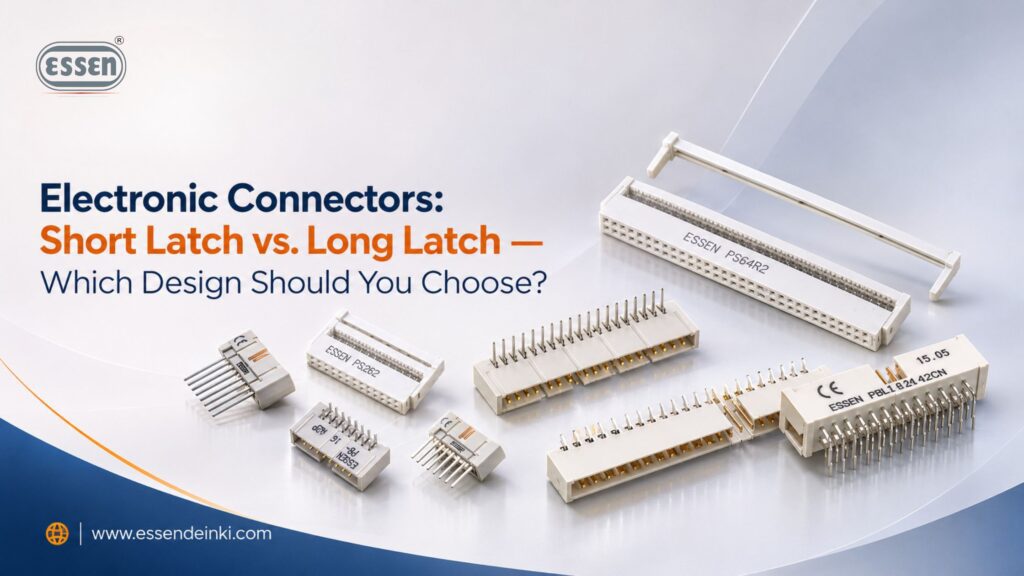
Choosing the right electronic connectors can make or break the reliability of an entire system. Engineers, OEMs, and procurement teams across India often face one recurring question: should you go with short latch or long latch electronic connectors? The answer depends on your application, assembly process, and the environment your equipment will operate in.
This guide breaks down the differences between short latch and long latch electronic connectors, explains their advantages and limitations, and helps you choose the right configuration for your next project. We’ll also look at how Essen Deinki’s P-Series electronic connectors support both designs, giving manufacturers flexibility without compromising on quality.
What Are Electronic Connectors?
Electronic connectors are components that join electrical circuits, allowing current or signals to pass between devices, PCBs, or cable assemblies. They play a critical role in industrial automation, control panels, consumer electronics, and telecommunications equipment.
A reliable electronic connector needs more than just good conductivity. It also needs a secure locking mechanism, resistance to vibration, and compatibility with your specific board layout. This is where latch design becomes important. Most electronic connectors, including those in Essen Deinki’s P-Series, are available with short latch, long latch, or no latch at all, depending on the application’s mechanical requirements.
Understanding Short Latch Connectors
Short latch electronic connectors feature a compact locking mechanism positioned close to the connector housing. This design keeps the overall footprint small, which is especially useful in space-constrained enclosures.
Design and Locking Mechanism
The short latch sits flush against the connector body. Consequently, it requires less clearance during installation, making it a practical choice for densely packed circuit boards.
Installation and Usability
Because the latch is smaller, installation is quick and straightforward. However, the reduced leverage can make it slightly harder to engage or release in tight spaces, particularly if access is limited from the sides.
Suitable Applications
Short latch electronic connectors work well in compact consumer electronics, control modules, and devices where board space is at a premium. Essen Deinki’s P-Series offers short latch variants (marked “SS” in the ordering code) across contact counts ranging from 10 to 64 pins.
Understanding Long Latch Connectors
Long latch electronic connectors use an extended locking arm that protrudes further from the connector housing. This design improves grip and makes manual operation easier.
Design and Locking Mechanism
The extended arm provides more leverage, which translates into a firmer, more secure lock. As a result, long latch connectors are often preferred in applications where vibration or frequent handling could loosen the connection.
Installation and Usability
Technicians generally find long latch connectors easier to engage and disengage, even in low-visibility or hard-to-reach locations. The added length allows for a better grip during assembly and maintenance.
Suitable Applications
Long latch electronic connectors are commonly used in industrial automation equipment, control panels, and machinery subjected to continuous movement or vibration. Essen Deinki’s P-Series includes long latch options (marked “SL” in the ordering code), available in the same 10 to 64 pin configurations as the short latch series.
Short Latch vs. Long Latch: Key Differences
While both designs serve the same core purpose—securing an electrical connection—they differ in a few meaningful ways:
- Footprint: Short latch connectors occupy less space; long latch connectors need more clearance.
- Grip and leverage: Long latch designs offer easier manual operation due to the extended arm.
- Vibration resistance: Long latch connectors tend to perform better in high-vibration environments.
- Assembly speed: Short latch connectors are quicker to install in automated or high-density assembly lines.
Understanding these distinctions helps engineers and procurement managers match the right electronic connector to the right application, rather than defaulting to one design across every project.
Comparison Table: Short Latch vs. Long Latch Electronic Connectors
| Feature | Short Latch Connectors | Long Latch Connectors |
| Footprint | Compact, saves PCB space | Requires more clearance |
| Locking mechanism | Flush, close to housing | Extended arm for better grip |
| Ease of manual operation | Moderate | High |
| Vibration resistance | Good | Excellent |
| Best suited for | Space-constrained designs | Industrial, high-vibration environments |
| Assembly speed | Faster in tight layouts | Slightly slower due to arm length |
| Available contact range (Essen Deinki P-Series) | 10 to 64 contacts | 10 to 64 contacts |
Advantages and Limitations of Both Designs
Short Latch Connectors
Advantages:
- Smaller footprint suits compact electronic devices.
- Faster to install on densely populated boards.
- Lower profile reduces interference with neighboring components.
Limitations:
- Reduced leverage can make release harder in confined spaces.
- May be less forgiving under continuous vibration.
Long Latch Connectors
Advantages:
- Stronger grip improves connection security.
- Easier to operate manually, even with limited visibility.
- Better suited for equipment exposed to movement or shock.
Limitations:
- Larger footprint requires additional board or enclosure space.
- Not ideal for ultra-compact device designs.
Applications Across Different Industries
Electronic connectors with short latch and long latch designs serve different industries based on their specific demands:
- Consumer electronics: Short latch connectors are common due to space limitations in compact devices.
- Industrial automation: Long latch connectors are preferred for their vibration resistance and ease of maintenance.
- Telecommunications equipment: Both designs are used, depending on enclosure size and signal requirements.
- Control panels and machinery: Long latch electronic connectors are often chosen for their secure locking under constant operation.
Essen Deinki’s P-Series connectors are also available without a latch (marked “SN”), giving engineers a third option when neither locking mechanism is required for the application.
Factors to Consider When Choosing the Right Connector
Before finalizing your choice of electronic connectors, consider the following:
1. Available space: Measure your enclosure or PCB layout to determine whether a compact or extended latch fits better.
2. Vibration and movement: For equipment exposed to continuous motion, long latch connectors typically offer more stability.
3. Assembly environment: High-volume automated assembly may favor short latch designs for speed.
4. Maintenance frequency: If connectors need regular disconnection and reconnection, long latch designs are easier to handle manually.
5. Contact count and plating: Match your current and voltage requirements with the right number of contacts and plating class.
Essen Deinki’s P-Series supports all these variables with 2.54 mm contact spacing, selective gold-plated contacts, and flame-retardant thermoplastic construction rated UL 94V-0, ensuring durability regardless of which latch style you select.
How Essen Deinki Supports Electronic Connector Requirements
Essen Deinki manufactures a wide range of electronic connectors designed for engineers, OEMs, and system integrators who need dependable performance across industrial and electronic applications. The P-Series is available in short latch, long latch, and no-latch configurations, covering contact counts from 10 to 64 pins.
Key features of Essen Deinki’s P-Series electronic connectors include:
- 2.54 mm contact and terminal spacing for precision alignment.
- Selectively gold-plated contacts for consistent signal quality.
- Polarized design with multiple latch options for secure locking.
- Flame-retardant thermoplastic housing (UL 94V-0) for safety and durability.
- Solvent-resistant materials built to withstand dynamic operating conditions.
For applications that demand a compact footprint, Essen Deinki also offers the PBL Profile Series, which includes low-profile connectors with straight and right-angle solder pin configurations, suited for space-saving PCB designs.
Why Choose Essen Deinki?
Essen Deinki has been manufacturing electronic components, including microswitches, connectors, limit switches, and electro-mechanical components, since 1964. With over 10,000 square meters of production space across three centers in Chandigarh and a presence in 15 countries, the company combines decades of engineering expertise with government-approved R&D and UL/CSA-compliant testing.
This long-standing manufacturing experience means Essen Deinki’s electronic connectors are built to meet the demands of Indian manufacturers, OEMs, and industrial buyers who need consistent quality at scale. Whether your project calls for short latch, long latch, or latch-free electronic connectors, Essen Deinki’s team can guide you toward the right configuration for your application.
Frequently Asked Questions
Q1. What is the main difference between short latch and long latch electronic connectors?
Short latch electronic connectors have a compact locking mechanism suited for space-constrained designs, while long latch connectors use an extended arm that offers stronger grip and easier manual operation, making them better suited for high-vibration environments.
Q2. Which latch design is better for industrial automation?
Long latch electronic connectors are generally preferred for industrial automation because they provide a more secure connection and are easier to engage or release during maintenance.
Q3. Does Essen Deinki offer custom electronic connector solutions?
Yes, Essen Deinki provides custom electronic connector solutions tailored to specific industrial requirements, including configuration, contact count, and plating class, based on application needs.
Q4. Are Essen Deinki’s electronic connectors suitable for PCB applications?
Yes, Essen Deinki’s P-Series and PBL Profile Series electronic connectors are fully compatible with PCB applications and are widely used in industrial automation, control panels, and electrical systems.
Choosing the Right Electronic Connector for Your Project
Selecting between short latch and long latch electronic connectors ultimately comes down to your specific application. If board space is limited and assembly speed matters, short latch connectors are the practical choice. If your equipment faces vibration, frequent handling, or demands a firmer lock, long latch connectors offer added security and ease of use.
Essen Deinki’s P-Series electronic connectors give you the flexibility to choose the configuration that fits your project, backed by over six decades of manufacturing expertise and government-approved quality standards.
Ready to find the right electronic connector for your application? Explore the full range of Essen Deinki electronic connectors or reach out to our team for a personalized consultation and product enquiry today.