

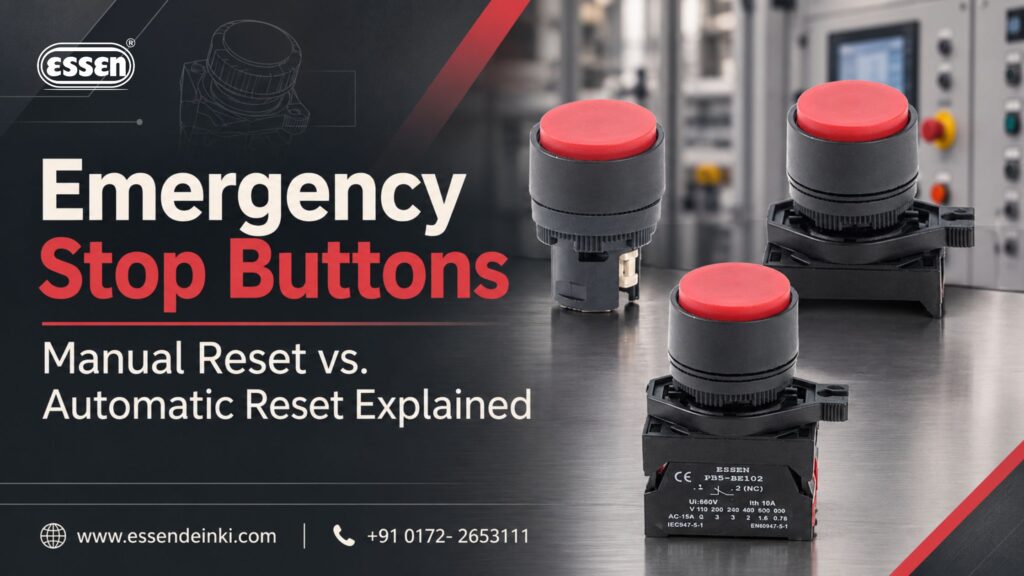
Quick answer: Emergency Stop Buttons typically use a manual reset mechanism, meaning an operator must deliberately release the latched actuator before machinery can restart. Automatic reset or return behaviour applies to certain control components, such as spring-return buttons, but it must never be confused with automatic machine restart. A compliant emergency stop function always requires a separate, deliberate start command after the hazard has been cleared.
Industrial machinery depends on dependable safety controls, and Emergency Stop Buttons sit at the centre of that protection. When a hazardous situation arises, these controls need to respond instantly and predictably. However, many engineers, panel manufacturers, and procurement teams in India still ask a common question: what happens after the emergency stop actuator is released?
This is where reset behaviour becomes important. Some Emergency Stop Buttons use a manual reset mechanism, requiring a deliberate operator action before the actuator releases. Other control components exhibit automatic return behaviour, which is a different concept altogether and should never be mistaken for an automatic machine restart.
This guide explains how manual reset and automatic reset mechanisms work, how they differ, and why the distinction matters for machine safety. It also introduces the PB5 Series and PB2 Series Emergency Stop Buttons from Essen Deinki, so that engineers and buyers in India can make informed, standards-conscious decisions for their control panels and machinery.
What Are Emergency Stop Buttons and How Do They Work?
Emergency Stop Buttons are safety components fitted to industrial machinery and control panels. Their purpose is simple: to stop a hazardous machine action as quickly as possible when a person activates them.
When an operator presses an Emergency Stop Button, several things happen in sequence:
1. The actuator is pressed, typically a red mushroom-head button that is highly visible on the panel.
2. A latching mechanism holds the actuator in its activated position, so it cannot be mistaken as released.
3. The safety circuit detects the change in state and triggers the stopping response configured for that specific machine.
4. The machine’s control system removes power from the hazardous function according to the designed stop category.
Because every machine’s risk profile is different, the stopping method and the overall safety circuit design will vary. For example, some systems cut power immediately, while others follow a controlled deceleration sequence before stopping. Therefore, machine builders must assess the required stop category during the design stage, not after installation.
Operator access and visibility also matter. Emergency Stop Buttons must be placed within easy reach at relevant operator stations, and their red colour against a yellow background should make them instantly recognisable, even in low-visibility industrial environments.
What Is a Manual Reset Emergency Stop Button?
A manual reset mechanism requires a deliberate action from an authorised person before the Emergency Stop Button’s actuator will release. This is one of the most common designs used in industrial emergency stop applications, because it prevents the actuator from popping back out on its own.
Common manual reset mechanisms include:
- Twist-to-release: The operator rotates the mushroom head to release the latch.
- Pull-to-release: The operator pulls the actuator outward to disengage the latch.
- Key-operated release: In certain applications, only an authorised person with a key can release the actuator.
Here is the typical operating sequence for a manual reset emergency stop button:
1. The operator presses the Emergency Stop Button during a hazardous event.
2. The actuator locks into its activated position.
3. The safety circuit changes state and triggers the configured stopping response.
4. The operator or maintenance team identifies and addresses the cause of the emergency.
5. An authorised person deliberately releases or resets the emergency stop actuator.
6. The safety system is checked and reset, where the control design requires this step.
7. A separate, dedicated start command is issued before the machine resumes operation.
This sequence matters because it prevents machinery from restarting unexpectedly. Most importantly, releasing the actuator does not, on its own, put the machine back into operation. A separate restart action is always required once the emergency condition has been cleared and the safety system confirms it is safe to proceed.
What Is an Automatic Reset Mechanism?
The term “automatic reset” needs careful explanation, because it is often misunderstood in the context of Emergency Stop Buttons.
Some control components, such as spring-return push buttons, are designed so that the actuator automatically returns to its original position once the operator releases pressure. This automatic return behaviour is a mechanical characteristic of the component itself. It is not the same as a compliant emergency stop function that allows a machine to restart automatically.
In other words, a spring-return button’s actuator springing back into place has nothing to do with whether the machine is permitted to run again. For an Emergency Stop Button specifically, the reset behaviour of the component must always match the intended safety function of the machine. A spring-return mechanism should not be substituted for a latching emergency stop mechanism without a proper engineering review and a standards-based risk assessment, such as one referencing IEC/EN 60947-5-1.
This is an important safety clarification: an emergency stop function must never cause machinery to restart automatically simply because the actuator has been released or reset. A deliberate, separate restart action is always required after the hazard is cleared and the safety system permits restarting.
Manual Reset vs. Automatic Reset: Key Differences
| Comparison Factor | Manual Reset | Automatic Return/Reset Behaviour |
| Operator involvement | Requires deliberate manual release | Component may return automatically after release |
| Actuator behaviour | Remains latched until released | Returns according to its mechanism |
| Typical use | Latching emergency stop applications | Suitable control functions where spring return is intended |
| Safety considerations | Supports deliberate acknowledgement and release | Must not bypass the required emergency stop safety sequence |
| Machine restart | Requires a separate start command | Must also require a separate start command where an emergency stop function is involved |
| Selection | Depends on the safety design | Depends on the intended control function |
The key takeaway is this: regardless of whether a component is designed with manual reset or automatic return behaviour, resetting the emergency stop actuator, resetting the safety control system, and restarting the machine are three distinct actions. None of these should happen automatically simply because another step has occurred.
Why Manual Reset Is Important in Industrial Safety
Manual reset mechanisms support safer machine recovery in several ways.
They prevent unexpected restarts. Because the actuator stays latched until someone deliberately releases it, there is no risk of the machine starting up while the hazard is still present.
They ensure the emergency condition has been investigated. An authorised person must check the cause of the stop before releasing the actuator, which builds a safety checkpoint into the recovery process.
They require deliberate operator action. This reduces the chance of accidental releases caused by vibration, incidental contact, or equipment malfunction.
They maintain clear responsibility during restart procedures. Because a human has to consciously release the actuator and then issue a separate start command, accountability for restarting the machine is clear.
It is worth noting that an Emergency Stop Button alone does not guarantee machine safety. It is one component within a broader machine safety system that should include risk assessments, guarding, interlocks, and properly designed control circuits.
Common Applications of Emergency Stop Buttons
Emergency Stop Buttons are used across a wide range of industrial settings in India and globally, including:
- Manufacturing machinery: Presses, CNC machines, and assembly equipment where rapid intervention protects operators.
- Packaging lines: High-speed packaging equipment where moving parts pose entrapment risks.
- Industrial automation systems: Automated cells and robotic workstations requiring accessible manual override.
- Conveyor systems: Long conveyor lines where stop stations are placed at intervals for operator access.
- Control panels: Panel-mounted Emergency Stop Buttons that interface directly with the machine’s safety circuit.
- Heavy equipment: Industrial machinery where sudden hazards require immediate operator intervention.
- Production machinery: General-purpose production lines where safety switches protect personnel during changeovers and maintenance.
In each case, accessible and correctly specified Emergency Stop Buttons help reduce response time during an emergency, which is why placement, visibility, and mechanism selection all matter.
PB5 Series Emergency Stop Buttons by Essen Deinki
The PB5 Series from Essen Deinki is a modular range of industrial safety switches designed for control panels and machinery applications. According to the product page, the PB5 Series offers the following characteristics:
- Modular construction
- Self-wiping contacts for trouble-free operation
- Shrouded terminals that protect against electrical shock
- Protection against electrical shock through earthed construction
- A locking device designed to remain secure against vibration
- Conformance to IEC/EN 60947-5-1
The PB5 range is available in several configurations:
| Configuration | Ordering Code | Description |
| Flush Type | PB5-EA( ) | Actuator |
| Flush Type | PCB5-EA( ) | Actuator and plastic bracket |
| Flush Type | PCB5-EA( )* | Actuator, plastic bracket, and contact block |
| Projecting Type | PB5-EL( ) | Actuator |
| Projecting Type | PCB5-EL( ) | Actuator and plastic bracket |
| Projecting Type | PCB5-EL( )* | Actuator, plastic bracket, and contact block |
| Booted Type | PB5-EP( ) | Available booted configuration |
| Latching Mushroom Head | PB5-ES 54 | Emergency stop configuration; press to lock and turn to release |
For emergency stop applications specifically, the latching mushroom-head variant (PB5-ES 54) uses a press-to-lock, turn-to-release mechanism. According to the PB5 Series product page, the range is designed for 22.5 mm panel cut-outs, features a high-visibility actuator, and offers turn-to-release functionality. The page also states the mechanism is rated for up to 3 million mechanical operations. It is worth noting that not every PB5 configuration includes every feature listed here, so engineers should confirm the exact specification required for their application before ordering.
Engineers and control panel manufacturers evaluating the PB5 Series should assess the required actuator style, mounting arrangement, contact configuration, and intended application before finalising their selection.
PB2 Series Emergency Stop Push Buttons by Essen Deinki
The PB2 Series is Essen Deinki’s push button switch range, which also includes a dedicated emergency stop configuration. The relevant variant is the Latching Mushroom Head (40 mm), available under the following ordering codes:
- PB2-BS 5( ): Actuator only
- PCB2-BS 5( ): Actuator with metal bracket
- PCB2-BS 5( )*: Actuator with metal bracket and contact block
This configuration uses the same press-to-lock, turn-to-release mechanism found in latching emergency stop designs, meaning the actuator latches when pressed and requires a deliberate twisting action to release. According to the PB2 Series product page, this emergency stop variant is available in red and black, with red as the standard emergency stop colour. An optional “E STOP” marking can also be added to the actuator using the suffix “E” in the ordering code.
The deliberate release action built into this design is important, because it prevents the actuator from disengaging accidentally and ensures a human decision is required before the stop condition is cleared.
It is important not to confuse the PB2 Series with the PB5 Series. While both ranges include latching mushroom-head emergency stop configurations with similar press-to-lock, turn-to-release mechanisms, their ordering codes and product construction are distinct, and specifications should always be verified separately.
PB5 Series vs. PB2 Series: Product Comparison
| Feature | PB5 Series | PB2 Series |
| Product type | Modular emergency stop button range | Push button switch range with emergency stop configuration |
| Available design | Flush, projecting, booted, and latching mushroom head | Flush, projecting, booted, mushroom head, and latching mushroom head |
| Emergency stop mechanism | Latching mushroom head, press to lock and turn to release | Latching mushroom head, press to lock and turn to release |
| Mounting information | 22.5 mm panel cut-out | Verify the applicable product configuration |
| Construction | Modular construction and self-wiping contacts | Modular configurations with actuator, bracket, and contact block options |
| Application | Industrial machinery and control panels | Industrial control panels and machinery applications |
How to Select the Right Emergency Stop Button for Your Application
Choosing the right Emergency Stop Buttons for a machine or control panel involves more than picking a red button. Engineers and procurement teams should assess:
- Machine type and risk assessment: What hazards does the machine present, and what response time is required?
- Required emergency stop function: Does the application require immediate power removal or a controlled stop?
- Manual latching and release requirements: Should the actuator remain latched until deliberately released?
- Actuator design and visibility: Is the mushroom head sized and positioned for quick, confident activation?
- Mounting and panel cut-out: Does the chosen model fit the panel’s standard cut-out, such as 22.5 mm?
- Contact configuration: How many NO/NC contacts does the safety circuit require?
- Electrical ratings and circuit compatibility: Will the switch handle the thermal current and voltage of the application?
- Applicable standards: Does the component conform to relevant standards such as IEC/EN 60947-5-1?
- Environmental conditions: Will the switch face dust, moisture, or vibration in its installed environment?
- Maintenance and inspection requirements: How often will the switch need to be checked for wear or contamination?
Product selection should always be based on the machine’s documented safety design, together with verified product specifications from the manufacturer, rather than assumptions about compatibility.
Common Mistakes to Avoid When Choosing an Emergency Stop Reset Mechanism
Several recurring mistakes can compromise the safety intent of Emergency Stop Buttons:
- Confusing actuator reset with machine restart. Releasing the actuator should never, by itself, cause the machine to run again.
- Using a spring-return button as an emergency stop without proper design validation. Automatic return behaviour in a component is not equivalent to a safe emergency stop sequence.
- Ignoring the latching requirement. A non-latching button may allow the stop condition to be cleared unintentionally.
- Choosing incompatible contact configurations. Mismatched NO/NC arrangements can create wiring errors in the safety circuit.
- Failing to assess the safety circuit as a whole. The button is only one part of a larger, interconnected safety system.
- Restarting machinery before checking the cause of the emergency. Skipping the investigation step undermines the entire purpose of the stop function.
Avoiding these mistakes starts with a clear understanding of the difference between resetting the actuator, resetting the safety control system, and restarting the machine — three separate actions that should never be treated as one.
Choose Reliable Emergency Stop Buttons from Essen Deinki
Essen Deinki has manufactured electro-mechanical and electronic components, including microswitches, connectors, and limit switches, since 1964. With manufacturing centres in Chandigarh and a presence across 15 countries, the company brings decades of engineering experience to its industrial safety switches, including the PB5 Series and PB2 Series Emergency Stop Buttons.
For industrial machinery manufacturers, control panel builders, and maintenance engineers in India, both ranges offer latching mushroom-head emergency stop configurations built to support deliberate, standards-conscious safety design. Explore the full Emergency Stop Button range, browse detailed specifications on the PB5 Series and PB2 Series pages, or view Essen Deinki’s complete product catalogue.
Choose the Right Reset Mechanism for Safer Machine Operation
Manual reset and automatic return behaviour serve different purposes within industrial control systems. A manual reset mechanism requires a deliberate operator action to release the Emergency Stop Button’s actuator, which helps prevent unexpected restarts and ensures the hazard has been addressed. Automatic return behaviour, found in components like spring-return buttons, describes how that specific part moves — it does not describe, and must never be mistaken for, an automatic machine restart.
Whatever reset mechanism is used, resetting the emergency stop actuator, resetting the safety control system, and restarting the machine must remain three separate, deliberate steps. Getting this right protects personnel, supports compliance with safety standards, and gives engineers confidence in their control panel designs.
If your team is specifying Emergency Stop Buttons for a new machine, retrofitting an existing control panel, or simply reviewing your current safety switches, Essen Deinki’s engineering team can help you work through the configuration, mounting, and contact requirements for the PB5 Series and PB2 Series. Contact Essen Deinki at +91 172 2653111–115 or info@essendeinki.com, or visit the Emergency Stop Button page to discuss your application in detail.
Frequently Asked Questions
Q1. What is the difference between a manual reset and an automatic reset emergency stop button?
A manual reset Emergency Stop Button requires an operator to deliberately release the latched actuator, typically by twisting or pulling it. Automatic reset refers to the return behaviour of certain components, such as spring-return buttons, and should not be confused with a latching emergency stop mechanism.
Q2. Does resetting an emergency stop button automatically restart a machine?
No. Resetting or releasing the emergency stop actuator must never, by itself, restart the machine. A separate, deliberate start command is always required once the safety system confirms it is safe to proceed.
Q3. Which emergency stop button models are available from Essen Deinki?
Essen Deinki offers the PB5 Series, which includes a latching mushroom-head configuration (PB5-ES 54), and the PB2 Series, which includes a latching mushroom-head emergency stop configuration (PB2-BS 5( )). Both use a press-to-lock, turn-to-release mechanism.
Q4. How can I choose the right emergency stop button for industrial machinery?
Base your selection on a documented risk assessment, the required stop category, panel mounting dimensions, contact configuration, and applicable standards such as IEC/EN 60947-5 1. Consulting with the manufacturer helps confirm the correct specification for your application.