

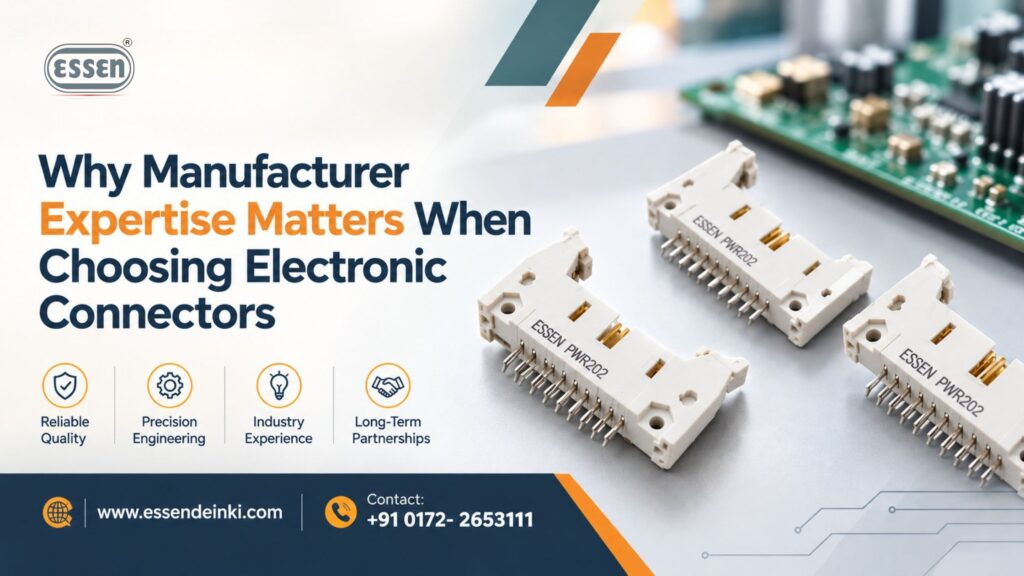
Quick answer: Manufacturer expertise matters because it directly affects connector fit, material quality, compliance documentation, and long-term reliability. Experienced electronic connectors manufacturers understand application requirements, maintain consistent production processes, and provide the technical support buyers need to avoid compatibility issues, premature failures, and avoidable replacement costs.
Choosing the right electronic connector is rarely as simple as matching a part number to a socket. For electrical engineers, procurement managers, and OEMs across India, a connector sits at the intersection of mechanical fit, electrical performance, and environmental durability. Get it wrong, and the consequences ripple through an entire system—intermittent signals, overheating contacts, or connectors that fail well before their expected service life.
This is where manufacturer expertise becomes a deciding factor. Working with experienced electronic connectors manufacturers means working with teams who understand how design choices, materials, and quality processes affect real-world performance. Buyers who choose suppliers based only on price or immediate availability often overlook these details, which can lead to compatibility problems and higher costs down the line.
In this article, we’ll explain what manufacturer expertise actually means in the context of electronic connectors, why it matters at every stage of selection, and how Indian businesses can evaluate potential suppliers before placing an order. We’ll also look at the risks of skipping this evaluation and share a practical checklist to guide your next sourcing decision.
What Does Manufacturer Expertise Mean in Electronic Connectors?
Manufacturer expertise refers to the accumulated technical knowledge a company applies to connector design, material selection, and quality control. Experienced electronic connectors manufacturers understand how contact spacing, plating, housing materials, and latch mechanisms interact with real operating conditions.
This expertise shows up in practical ways. A knowledgeable manufacturer can explain why a particular contact plating suits a corrosive environment, or why a specific pin spacing is appropriate for a given PCB layout. For Indian industrial buyers working across sectors like automation, instrumentation, and control panel manufacturing, this kind of practical guidance can shorten the sourcing process and reduce the risk of selecting an unsuitable part.
Technical knowledge alone isn’t enough, though. It needs to be paired with consistent manufacturing practices and clear documentation—both of which we’ll explore in more detail below.
Why Manufacturer Expertise Matters When Choosing Electronic Connectors
Product Quality and Consistency
Consistent manufacturing processes help ensure that every connector in a batch performs the same way. For example, variations in contact plating thickness or housing tolerances can affect how reliably a connector mates and holds its connection over time.
Electronic connectors manufacturers who follow structured quality checks are better positioned to catch these variations before products reach the buyer. As a result, purchasing teams face fewer surprises during incoming inspection or installation.
Technical Knowledge and Product Selection
A connector that works well in one application may be entirely unsuitable in another. Technical expertise helps manufacturers—and the buyers they work with—match connectors to the correct electrical ratings, mechanical fit, and environmental conditions.
For instance, a connector intended for a low-vibration consumer device will likely need different mechanical retention features than one destined for industrial machinery. Experienced electronic connectors manufacturers can flag these distinctions early, before a buyer commits to the wrong part.
Application-Specific Solutions
Connector requirements vary significantly across consumer electronics, industrial equipment, control systems, and instrumentation. A connector that performs well in a stationary control panel may not hold up in a mobile or vibration-prone setting.
Therefore, understanding the end application is just as important as understanding the connector itself. This is where application-specific knowledge from an experienced supplier becomes valuable—particularly for OEMs designing products for multiple use cases.
Material and Design Understanding
Contact materials, insulation types, and housing design all influence how a connector performs under load and over time. Flame-retardant thermoplastics, for example, are often specified for safety-critical applications, while gold-plated contacts are commonly used where signal quality and corrosion resistance matter most.
Manufacturers with strong design understanding can explain these trade-offs clearly, helping buyers choose connectors suited to their specific operating environment—whether that’s a dusty industrial floor or a temperature-controlled lab.
Performance and Long-Term Reliability
Suitable connector selection can help reduce avoidable connection problems and unplanned maintenance. However, it’s worth noting that manufacturer expertise improves the odds of a good outcome—it does not guarantee failure-free performance in every scenario, since field conditions and installation practices also play a role.
That said, buyers who work with knowledgeable suppliers are generally better equipped to anticipate and plan for the operating conditions their connectors will face.
Compliance and Technical Documentation
Checking applicable standards, ratings, and test documentation is a practical step that’s easy to overlook under time pressure. Experienced electronic connectors manufacturers typically maintain clear datasheets, dimensional drawings, and relevant compliance information that buyers can review before finalizing an order.
This documentation matters for engineering sign-off, quality audits, and future design reference—particularly for OEMs that need to maintain traceable specifications across multiple product lines.
Technical Support and Communication
Clear communication between a manufacturer’s technical team and a buyer’s engineering or procurement staff can prevent costly misunderstandings. When questions arise about contact ratings, mounting orientation, or latch configuration, responsive technical support helps resolve them before production delays occur.
Consistency for Repeat Orders
For OEMs and businesses placing recurring orders, consistency matters as much as initial quality. Electronic connectors manufacturers that maintain stable specifications across production runs make it easier for buyers to plan assembly lines and avoid last-minute design changes.
Risks of Choosing Electronic Connectors Without Evaluating Manufacturer Expertise
Selecting a connector supplier based solely on the lowest price or fastest availability carries certain risks. Incomplete specifications or limited technical information can make it difficult to confirm whether a connector truly fits the intended application.
Potential issues include incorrect mechanical fit, unsuitable voltage or current ratings, and compatibility problems with existing mating connectors. In some cases, inconsistent specifications between batches can create rework or replacement costs that outweigh any initial savings.
These are possible outcomes rather than certainties—many low-cost suppliers do offer acceptable quality. However, without proper evaluation, buyers take on more uncertainty than necessary.
How to Evaluate Electronic Connectors Manufacturers in India
Before finalizing a supplier, it’s worth confirming the following:
- Relevant product and application knowledge demonstrated by the manufacturer’s team.
- Availability of clear product specifications, datasheets, and dimensional drawings.
- Appropriate electrical and mechanical ratings for your specific use case.
- Quality control practices and traceability, where applicable to your industry.
- Relevant certifications or compliance documentation, where required.
- Ability to clarify technical queries promptly and accurately.
- Consistency of product specifications across repeat orders.
- Suitability of the connector range for your intended application.
- Commercial terms, lead times, and after-sales support.
These factors should be verified directly with each supplier rather than assumed. Not every electronic connector manufacturer will offer the same level of documentation or support, so due diligence during sourcing pays off later.
Why Application Requirements Should Guide Connector Selection
Ultimately, connector selection should be driven by the actual use case rather than convenience or habit. Relevant considerations include current and voltage ratings, contact configuration, mounting requirements, mating compatibility, operating temperature range, exposure to vibration or moisture, and the expected number of connection cycles.
For example, a connector intended for a control panel inside a climate-controlled facility has very different requirements than one used in an outdoor industrial enclosure. When these requirements aren’t fully clear, it’s worth reviewing the product datasheet closely and consulting a qualified technical professional before finalizing a purchase.
Price-Only vs. Expertise-Focused Selection: A Comparison
The table below illustrates how a price-only approach to sourcing compares with one that prioritizes manufacturer expertise.
| Selection Factor | Price-Only Approach | Expertise-Focused Approach |
| Product suitability | May overlook application requirements | Evaluates the intended application and specifications |
| Technical documentation | May receive limited attention | Checks relevant ratings, drawings, and datasheets |
| Quality evaluation | Focuses mainly on purchase price | Considers available quality processes and consistency |
| Compatibility | May not be fully assessed | Reviews fit, configuration, and mating requirements |
| Long-term cost | May overlook replacement and maintenance costs | Considers the overall cost of ownership |
| Technical support | May be limited or unclear | Evaluates the availability of useful technical guidance |
As the comparison shows, an expertise-focused approach doesn’t necessarily cost more upfront—it simply accounts for factors that affect performance and cost over the connector’s working life. Not every low-cost option is a poor choice, and not every expertise-focused supplier is automatically the best fit. The goal is to evaluate each option against your specific requirements.
Evaluating Essen Deinki for Your Connector Requirements
Essen Deinki has been manufacturing electronic components, including connectors, microswitches, and electro-mechanical parts, since 1964, with production facilities across Chandigarh and a presence in 15 countries. Its connector range includes the P-Series and PBL Profile Series, which feature selective gold-plated contacts, flame-retardant thermoplastic housings, and polarized designs with multiple latch configurations.
If you’re evaluating electronic connectors manufacturers for an upcoming project, it’s worth reviewing Essen Deinki’s product specifications directly. You can explore electronic connectors to compare contact counts, latch styles, and plating options against your application requirements.
Reviewing this information alongside your technical specifications—and discussing any open questions with the manufacturer’s team—can support a more informed purchasing decision, whether you’re sourcing a single prototype batch or planning a recurring supply arrangement.
Frequently Asked Questions
Why is manufacturer expertise important when choosing electronic connectors?
Manufacturer expertise helps ensure that a connector’s design, materials, and ratings genuinely match the intended application. Experienced electronic connectors manufacturers can guide buyers toward suitable configurations and flag potential compatibility issues before they become costly problems.
What should buyers check before selecting electronic connectors manufacturers in India?
Buyers should verify technical documentation, applicable ratings, quality control practices, and the manufacturer’s ability to answer specific application questions. Checking consistency across repeat orders and confirming lead times are also worthwhile steps.
How can technical documentation help when choosing electronic connectors?
Datasheets, dimensional drawings, and ratings information allow engineers to confirm electrical and mechanical compatibility before purchase. This documentation also supports internal quality audits and simplifies future reordering.
How can businesses enquire about electronic connectors from Essen Deinki?
Businesses can review product details on the Essen Deinki electronic connectors page and reach out through the company’s official contact channels to discuss specific application requirements or request further product information.
Making an Informed Connector Choice
Choosing the right connector involves more than comparing price tags. It requires evaluating technical knowledge, product suitability, documentation, and the manufacturer’s ability to support your specific application. Partnering with experienced electronic connectors manufacturers gives engineering and procurement teams the information they need to make confident, well-supported sourcing decisions. If you’re currently sourcing connectors for an upcoming project, take the time to review specifications closely and ask suppliers the right questions before committing. Visit the Essen Deinki electronic connectors page to explore the P-Series and PBL Profile Series, and reach out to discuss your specific requirements with their team.